Best Puppy Food for Boxer Puppies
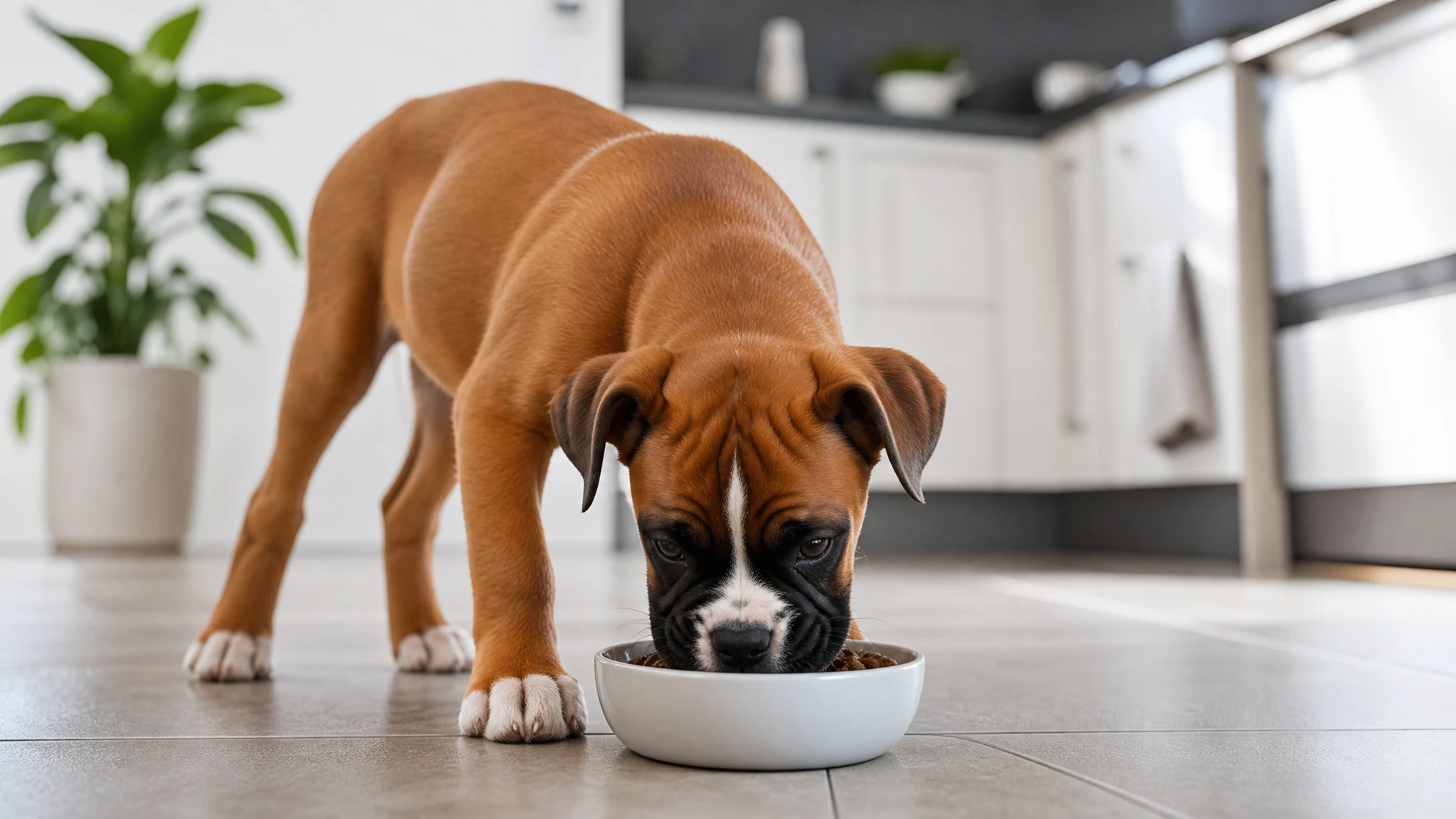
General nutrition information compiled from product labels and published sources, not veterinary advice. Your veterinarian is the right person to choose a diet for your dog, especially one with a health condition.
Choosing boxer puppy food is mostly an exercise in reading labels. Bags are covered in claims about ancestry, freshness and "natural" ingredients. The small print on the back tells you much more.
This guide covers how to find the best puppy food for Boxers by comparing label data. It also covers how often to feed, and when to move on to adult food. We compared label data from brand pages. We did not run feeding trials or taste tests, and we are not ranking foods by how a puppy responds to them.
Start with the Boxer's size
PetMD describes the Boxer as a medium dog, usually about 65 to 80 pounds as an adult, with an average height of 21 to 25 inches. That puts the breed close to a line that matters on pet food labels.
According to the Whole Dog Journal's explanation of nutritional adequacy statements, foods labeled for growth or for all life stages must say whether they meet the AAFCO profile "including" or "except for" growth of large-size dogs. Large-size means 70 pounds or more as an adult. "Including" means the food is formulated for large-breed puppies. "Except for" means it is not.
Many male Boxers reach or pass 70 pounds. So a Boxer puppy can be fed a food whose label says "including growth of large-size dogs." This is a reasonable label check, not a rule. The sources we reviewed do not say it is required for Boxers, and your veterinarian can tell you what suits your puppy.
Why growth wording gets so much attention
A literature review inside a case report in the Canadian Veterinary Journal (Tal et al., 2018) links excess energy and excess calcium during growth to developmental orthopedic disease in large-breed puppies. It states that excess energy during growth promotes rapid growth and these disorders.
That is why large-breed puppy foods are formulated differently from general puppy foods. We found no Boxer-specific calcium guidance, and no source we reviewed gives a calcium maximum. If you want to know whether a food's calcium level is right for your puppy, ask the brand for its figures and ask your veterinarian to interpret them.
No food is a guarantee against any joint or growth problem. A veterinarian decides what is right for an individual dog.
What to look for on the label
1. A complete and balanced statement for growth
Look for a nutritional adequacy statement that names growth or all life stages. A statement that says "maintenance" or "adult" only is not a puppy food.
Then find the large-size wording. "Including growth of large size dogs" is what you want to see. "Except for growth of large size dogs" is a flag for a Boxer likely to pass 70 pounds.
2. How the food was substantiated
Some statements say the food was formulated to meet AAFCO nutrient profiles. Others say animal feeding tests using AAFCO procedures substantiate it. Both are legitimate routes. The wording tells you how the claim was made, not how good the food is.
3. The first ingredients
The first five ingredients show what dominates the recipe by weight, though water and fresh meat weigh differently from meals. A named animal protein near the top is a reasonable sign. A list is not a quality score on its own, so read it next to the guaranteed analysis.
4. Guaranteed analysis and calories
Check minimum protein and fat, maximum fiber, and calories per cup. Calories matter because the Tal review ties excess energy to fast growth. A food with more calories per cup needs a smaller portion, so compare calories and not only cup sizes.
PetMD also notes that Boxers need quality protein for healthy muscles, including the heart. That is general breed guidance, not a diet treatment for any condition.
5. A feeding guide you can follow
A good label has a feeding chart by weight or age. Treat it as a starting point. Adjust to your puppy's body condition with your veterinarian's advice.
Key features compared
The table lists foods from the brand pages whose statements cover growth. Where a page did not give a figure, we say so rather than guess.
| Food | Form | Growth wording | Calories | First five ingredients |
|---|---|---|---|---|
| VICTOR Elite Canine | Dry | All life stages, including growth of large size dogs (70 lb or more as an adult) | 386 kcal per cup | Chicken meal, whole grain brown rice, grain sorghum, peas, chicken fat |
| Hill's Science Diet Puppy Large Breed Chicken & Brown Rice | Dry | Large breed puppies (over 55 lb as adults) up to 18 months; growth statement, check page for large-size wording | 387 kcal per cup | Chicken, brown rice, whole grain oats, chicken meal, cracked pearled barley |
| Nom Nom Chicken Cuisine | Fresh, gently cooked, frozen | All life stages including growth of large-size dogs, per the brand page | 244 kcal per cup | Chicken, sweet potatoes, squash, spinach, dicalcium phosphate |
| JustFoodForDogs Pantry Fresh Chicken & Rice | Fresh, shelf-stable | All life stages; confirm large-size wording on the brand page | 387.5 kcal per 12.5 oz pack | Chicken breast, chicken thighs, chicken liver, long-grain white rice, kale |
For the VICTOR and Hill's dry foods, the pages give a per-cup figure. The Nom Nom page gives 244 kcal per 219 g cup. JustFoodForDogs lists calories per pack, not per cup.
Picks by type of food
We do not list prices. Prices change and vary by seller, and none were in the sources we reviewed. Instead, here are the picks by form, so you can match the food to how you want to feed. Check each brand's own page for current pricing.
Dry food with explicit large-size growth wording
VICTOR Elite Canine has the clearest label for this purpose. Its statement says it meets AAFCO Dog Food Nutrient Profiles for all life stages, including growth of large size dogs (70 lb. or more as an adult). Guaranteed minimums are 25 percent protein and 14 percent fat, with 4 percent fiber at most. It is 386 kcal per cup.
The first ingredient is chicken meal, and the recipe includes peas and grain sorghum. It is not grain-free. VICTOR's page suggests puppies be fed as much as they eat in 20 minutes, four times a day. Treat that as one brand's guide and talk it over with your veterinarian.
Read the details on the VICTOR Elite Canine page.
Dry food made for large-breed puppies
Hill's Science Diet Puppy Large Breed Chicken & Brown Rice Recipe is labeled for large breed puppies, those over 55 pounds as adults, up to 18 months. The page lists 387 kcal per cup. It also gives dry matter averages of 26.7 percent protein, 15.4 percent fat and 2.8 percent crude fiber. These are averages, not guaranteed minimums.
The page's statement says animal feeding tests using AAFCO procedures substantiate complete and balanced nutrition for growing puppies. We could not confirm from our notes whether it names large-size growth specifically, so read the full statement on the page before you decide. The page includes a chart by weight and age band and suggests a 7-day transition.
See the Hill's Science Diet Puppy Large Breed page.
Fresh food
Fresh foods cost more to ship and store, and they need refrigeration or freezing, so the practical side matters. Two fresh foods reviewed here cover growth.
Nom Nom Chicken Cuisine says it is formulated to meet AAFCO Dog Food Nutrient Profiles, and the brand page continues with all life stages including growth of large-size dogs. It lists 6.5 percent protein, 4.5 percent fat and 3.5 percent fiber, as fed. Because it is high in moisture, compare it to dry foods on a dry matter basis or by calories, not by raw percentages. See the Nom Nom Chicken Cuisine page.
JustFoodForDogs Pantry Fresh Chicken & Rice is a shelf-stable cooked food for all life stages. It lists 6.5 percent protein, 2.5 percent fat and 1 percent fiber. The brand's page also mentions large-size growth, but check the exact statement there. Its feeding amounts come from a calculator on the brand's page. See the JustFoodForDogs Pantry Fresh page.
A breed-specific option: check with the brand
Royal Canin makes a Boxer Adult formula for purebred Boxers 15 months and older. Its statement is for maintenance, so it is not a puppy food. We did not find a Royal Canin Boxer puppy product in the sources we reviewed. If you want a breed-specific puppy line, check Royal Canin's own site.
Red flags to avoid
- "Except for growth of large size dogs." VICTOR Hi-Pro Plus and VICTOR Chicken and Rice Formula Pate both carry this wording. They are legitimate foods, but they are not formulated for large-breed puppy growth. The Hi-Pro Plus page lists 406 kcal per cup, 30 percent protein and 20 percent fat. Boxers are usually under 70 pounds as adults, but check with your veterinarian.
- Adult maintenance statements. Hill's Adult Large Breed, the canned Adult Chicken & Barley and the Freshpet Home Cooked Chicken Recipe are labeled for adults. A large-breed adult formula is not a large-breed puppy formula.
- No adequacy statement at all. If you cannot find "complete and balanced" with a life stage, the food may be a topper or supplement.
- Claims that a food prevents or treats a disease. Diet can matter for a dog's health, but no food bag can promise to prevent hip dysplasia, heart disease or bloat. Prescription diets are something only a veterinarian prescribes.
- Home recipes without a formulation behind them. Puppies have narrow nutrient needs during growth, particularly for calcium. Ask a veterinarian before moving away from a complete and balanced food.
- Treating "grain-free" as a mark of quality. The FDA has not found a definitive diet link to non-hereditary dilated cardiomyopathy (DCM) in dogs, and has not asked for any recalls. It counted 1,382 DCM reports from January 1, 2014 to November 1, 2022. In its Q&A, current as of August 19, 2024, the FDA says it "does not know the specific connection between these diets and cases of non-hereditary DCM." Its main investigation page says it will not release further public updates until there is meaningful new scientific information. None of the foods in the table above is labeled grain-free on its page. The more useful question for most owners is whether the food has a sound adequacy statement.
How often to feed a Boxer puppy
Puppies generally eat several small meals a day. VICTOR's puppy guide suggests four feedings a day, and your veterinarian can set a schedule for your puppy's age.
Boxers are a deep-chested breed, and PetMD lists bloat (GDV) among the breed's concerns. For adults it advises two meals a day about 12 hours apart, no raised food bowls, and slow feeder bowls. That advice is for adult dogs, so ask your veterinarian when and how to shift a puppy toward it.
Feeding charts on the bag are starting points. Watch your puppy's body condition and weight, and adjust with your veterinarian's advice. PetMD also lists excess weight and joint strain among the breed's diet-relevant concerns, so keeping a puppy lean is a sensible goal.
When to switch to adult food
There is no single Boxer switch age in the sources we reviewed. PetMD gives none and tells owners to ask the veterinarian.
The Kennel Club (UK) offers a general rule: dogs over 26 kg, about 57 pounds, reach adulthood between 15 months and 2 years. That is a rule for larger dogs, not a Boxer-specific one. Hill's large breed puppy food is labeled for up to 18 months, and Royal Canin's Boxer Adult formula starts at 15 months.
When you do switch, Hill's page suggests a 7-day transition for its puppy food, and VICTOR's senior page suggests 7 to 10 days. Mixing old and new food gradually is a reasonable approach with any brand. Ask your veterinarian about timing.
Where to buy
We do not link retailers. The most reliable starting point is the brand's own website, where you can read the full adequacy statement and feeding guide. Several of these brands also list stores near you or sell direct. Check each brand's page for how to purchase.
Whichever place you buy from:
- Compare the bag's printed statement with the brand page. Formulas get updated.
- Check the "best by" date and that the packaging is intact.
- For fresh foods, follow the brand's storage rules. Freshpet's page, for example, says to use its food within 7 days of opening, and other fresh brands have their own rules.
- Buy a bag size your puppy will finish before it goes stale, since a growing puppy's needs and portions change quickly.
A short checklist
- Find the adequacy statement. It should name growth or all life stages.
- Look for "including growth of large size dogs."
- Compare calories per cup, and size portions from the feeding guide.
- Read the first five ingredients and the guaranteed analysis together.
- Introduce the food over about a week.
- Ask your veterinarian about meal frequency, weight checks and the switch to adult food.
The best food for a Boxer puppy is one with a clear growth statement, sensible calories, and a form you can feed consistently. Your veterinarian can confirm what fits your puppy.
Sources
- PetMD, Boxer breed page
- Tal et al., Canadian Veterinary Journal 2018 (PMC5731398)
- Whole Dog Journal, In the Fine Print: Nutritional Adequacy Statements
- The Kennel Club (UK), Puppy food to adult food
- FDA CVM, Questions and Answers on non-hereditary DCM in dogs
- FDA, Investigation into a potential link between certain diets and canine DCM
- VICTOR Pet Food, Elite Canine
- VICTOR Pet Food, Hi-Pro Plus
- Hill's Pet Nutrition, Science Diet Puppy Large Breed
- Nom Nom, Chicken Cuisine
- JustFoodForDogs, Pantry Fresh Chicken & Rice
- Royal Canin US, Boxer Adult