Boxer Portion Sizes: Adjusting Feeding Amounts for Activity Level
General nutrition information compiled from product labels and published sources, not veterinary advice. Your veterinarian is the right person to choose a diet for your dog, especially one with a health condition.
Two Boxers can weigh the same and still need different amounts of food. One spends the day on the couch. The other runs for an hour every morning. So how much food should a Boxer eat? The honest answer is a starting point from the bag, then small changes based on what you see.
This guide walks through that process in steps. It uses label feeding guides as the starting point and your dog's body shape as the check. For a breakdown by age and weight, see the Boxer feeding chart by age and weight.
A note on method: we compared label data from the brands' own pages. We did not run feeding trials or taste tests, so nothing here says a food worked for any dog.
What You Need
- The bag or can of the food you feed, with its feeding guide and calorie statement (kcal per cup or per can).
- A standard measuring cup, or a kitchen scale that weighs in grams.
- A bathroom scale or a vet-office scale to track your dog's weight.
- A notebook or phone note for weights and portions.
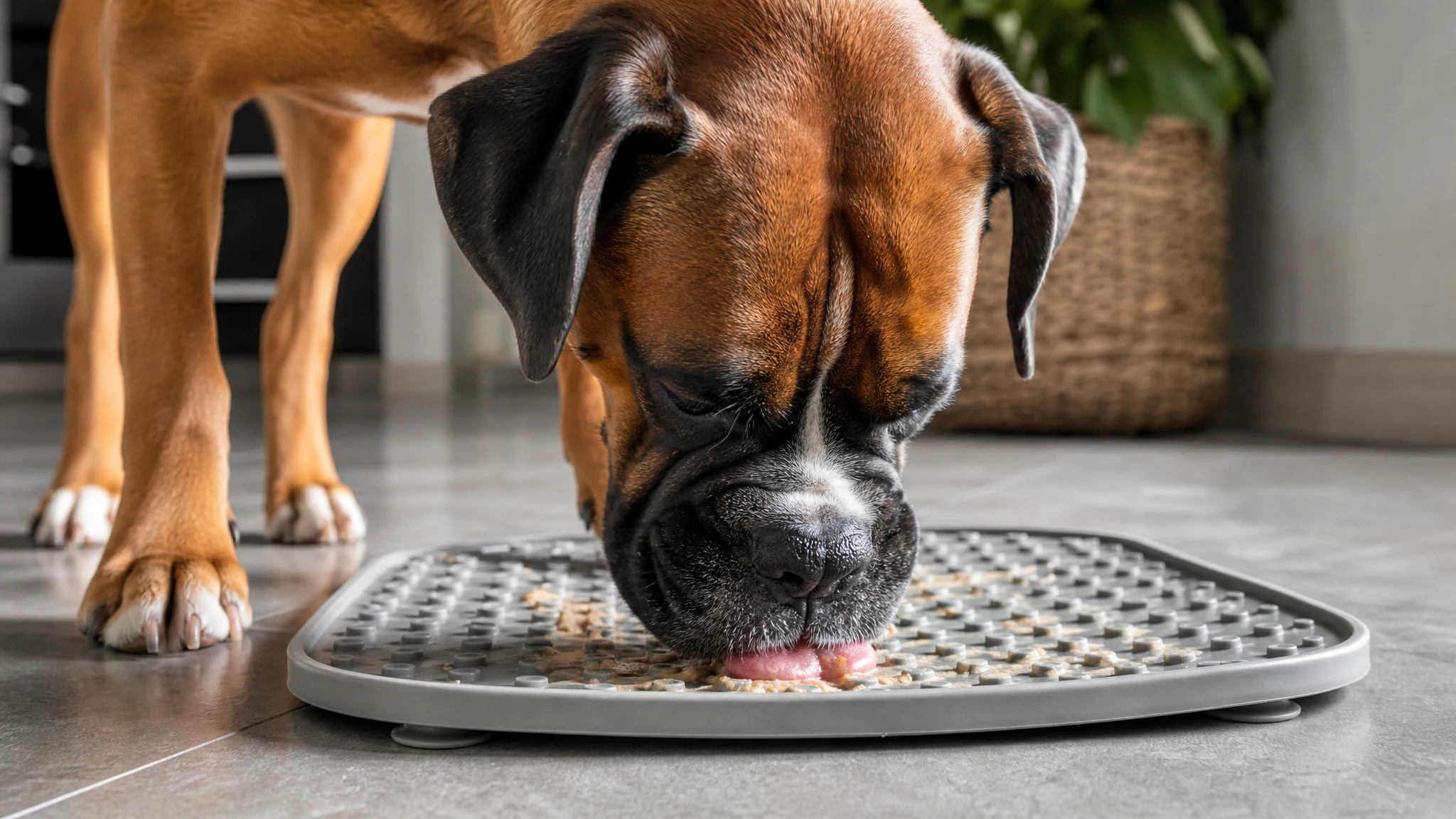
- A slow feeder bowl, which PetMD suggests for Boxers because of bloat risk.
Why Boxer Portions Need Adjusting
PetMD describes the Boxer as a medium-sized dog, usually about 65 to 80 pounds, with heights of about 21 to 25 inches. That is a wide range, and the feeding guide on a bag is built around weight bands.
A feeding guide is an average. It cannot know if your dog is a sprinter, a sofa sleeper or a neutered adult with a slow metabolism. PetMD also lists excess weight and joint strain among the health concerns for the breed. That is a good reason to adjust portions to your own dog and not simply fill the cup.
Step 1: Find the Label Guide for Your Dog's Weight
Start with the guide on the food you already feed. Find your dog's current weight in the table, then read across to the daily amount. Treat it as a total for the whole day, not for each meal.
Brands present these guides differently, which is why you should never carry a number over from one food to another. Here are examples from the brands' own pages:
- Royal Canin's Boxer Adult dry food lists 2 7/8 cups (253 g) a day for a 53 pound dog at its "Activity +" level. It also has separate dry and mixed feeding tables by weight and activity.
- Hill's Science Diet Adult Large Breed lists 3 1/4 cups a day for a 50 pound dog and 5 1/3 cups for a 100 pound dog, and says to adjust to maintain optimal weight.
- VICTOR Elite Canine lists 5 1/8 cups a day for a 100 pound dog on an 8 ounce cup.
The foods differ in energy. Royal Canin Boxer Adult is listed at 335 kcal per cup, Hill's Adult Large Breed at 365 kcal per cup, and VICTOR Elite Canine at 386 kcal per cup. A cup of one food is not the same as a cup of another. If you switch foods, read the new guide from scratch.
The Royal Canin Boxer Adult formula is labeled for purebred Boxers 15 months and older. Check the brand's own page for its current guide.
Step 2: Judge Your Dog's Activity Level Honestly
Pick the description that fits an average week, not your best week.
- Low: short leash walks, mostly indoors, lots of napping.
- Moderate: daily walks plus some play, a typical pet routine.
- High: long runs, hikes, sports or several hard play sessions most days.
Some labels, like Royal Canin's, build activity into the table. Others, like Hill's, simply tell you to adjust to maintain optimal weight. In that case, the activity adjustment is up to you and your vet.
Step 3: Start at the Label Amount and Make Small Moves
For a dog with a moderate routine, begin at the label amount for the current weight. For a clearly low-activity dog, many owners begin at the lower end of what the guide shows. For a high-activity dog, they begin toward the upper end.
Keep changes small. A modest step, such as a small scoop more or less per day, is easier to read than a big jump. Change one thing at a time so you know what caused any difference.
Do not count on a single number to be right. The label figure is a starting point, and your dog's body will tell you what to do next.
Step 4: Count Everything That Goes In
Treats, chews, dental sticks and table scraps all add calories. If your Boxer gets a lot of training treats, take that amount out of the meals. Using part of the daily kibble as training rewards is an easy way to do this.
Measure with the same cup every time. A scoop that looks like one cup is often more. If you want better accuracy, weigh the portion in grams. The Royal Canin example above shows grams alongside cups for this reason.
Step 5: Split the Day Into Two Meals
PetMD advises feeding Boxers two meals a day, about 12 hours apart. It also advises against raised food bowls and suggests slow feeder bowls. These are the page's recommendations for bloat (GDV) risk, and they do not guarantee any outcome.
In practice, divide the daily amount in half. Serve one portion in the morning and one in the evening. Keep the evening meal calm and avoid hard exercise right before or after eating. If you are unsure how to time meals around exercise, ask your vet.
Step 6: Check Weight and Body Shape Every Week
Weigh your dog weekly, at the same time of day, and write it down. Then check the body by touch and by sight:
- You should be able to feel the ribs under a thin layer of padding without pressing hard.
- Seen from above, there should be a visible waist behind the ribs.
- Seen from the side, the belly should tuck up toward the hind legs.
If ribs are hard to feel and the waist is gone, the portion may be too large for that activity level. If ribs and hip bones are very easy to see, it may be too small. Either way, make a small change and recheck in two to three weeks. Your vet can score body condition and tell you what a healthy weight looks like for your dog.
Step 7: Re-Adjust When Life Changes
Revisit the amount whenever something shifts: a new training schedule, a season of long hikes, an injury that limits exercise, or the move into older age. A food built for a different life stage will also change the math, as Hill's Adult 6+ Large Breed, at 352 kcal per cup, does compared with its adult formula.
A Note on Puppies
Puppies are a different case. A review in the Canadian Veterinary Journal (Tal et al., 2018) links excess energy during growth to rapid growth and developmental orthopedic disease in large-breed puppies. So portions matter, and a puppy should not be free-fed.
Boxers sit near the AAFCO large-size cutoff of 70 pounds as adults, and males can reach 65 to 80 pounds. A Boxer puppy can be fed a food whose label says it meets the profile "including growth of large-size dogs." That is an option, not a requirement. Foods labeled "except for growth of large-size dogs," such as VICTOR Hi-Pro Plus, are not meant for large-breed puppies. Ask your vet which fits your puppy.
For the switch to adult food, PetMD gives no age for Boxers and says to ask your vet. The UK Kennel Club says dogs over about 57 pounds usually reach adulthood between 15 months and 2 years. That is a general rule for larger dogs, not a Boxer rule.
Tips
- Take photos from above and from the side once a month. Slow changes are easier to spot in pictures.
- Change foods gradually. Hill's, for example, suggests a 7 day transition on its puppy food page.
- Keep the same feeding times from day to day so your dog settles into a routine.
- Use a slow feeder bowl if your Boxer gulps its food.
Common Mistakes to Avoid
- Copying a cup amount from another dog. Calories per cup range widely between foods, as the label figures above show.
- Feeding by the bag's top weight band. Use your dog's actual weight, not the one you hope for.
- Forgetting treats. They count toward the day's calories.
- Raising the bowl. PetMD advises against raised bowls for Boxers.
- Big, fast changes. Small steps and weekly checks tell you more.
- Treating food as medicine. No food is shown here to prevent or treat any condition.
Boxers With Health Conditions
PetMD lists ARVC (Boxer cardiomyopathy) as a concern for the breed and notes that Boxers need quality protein for healthy muscles, including the heart. It gives no diet cure. The American Boxer Club health page says diet and conditioning cannot be ruled out as factors in hip dysplasia, but it gives no specific diet advice. It also gives no diet advice for chronic kidney disease.
On diet and heart disease in dogs more broadly, the FDA says it has not found a definitive diet link to non-hereditary DCM and has not asked for any recalls. It also says it does not know the specific connection between certain diets and those cases. If your Boxer has any heart, joint, kidney or weight problem, confirm portions and food choice with your vet. Prescription diets are only something a veterinarian prescribes.
What to Expect
If the amount suits your dog, you may see steady weight, a visible waist and an energy level that holds through the day. Some owners also notice firmer stools and better focus during training. Results vary from dog to dog, and no feeding plan can promise an outcome.
If your dog's weight keeps drifting up or down after a few small changes, or if appetite changes suddenly, call your vet. Do not keep guessing.
Sources
- PetMD Boxer breed page
- American Boxer Club health page
- Tal et al., Can Vet J 2018 (PMC5731398)
- The Kennel Club (UK), Puppy food to adult food
- FDA CVM, Questions and Answers on non-hereditary DCM in dogs
- Royal Canin Boxer Adult product page
- Hill's Science Diet Adult Large Breed product page
- Hill's Science Diet Adult 6+ Large Breed product page
- VICTOR Elite Canine product page
- VICTOR Hi-Pro Plus product page