Boxer Puppy Feeding Chart: Cups Per Day by Weight
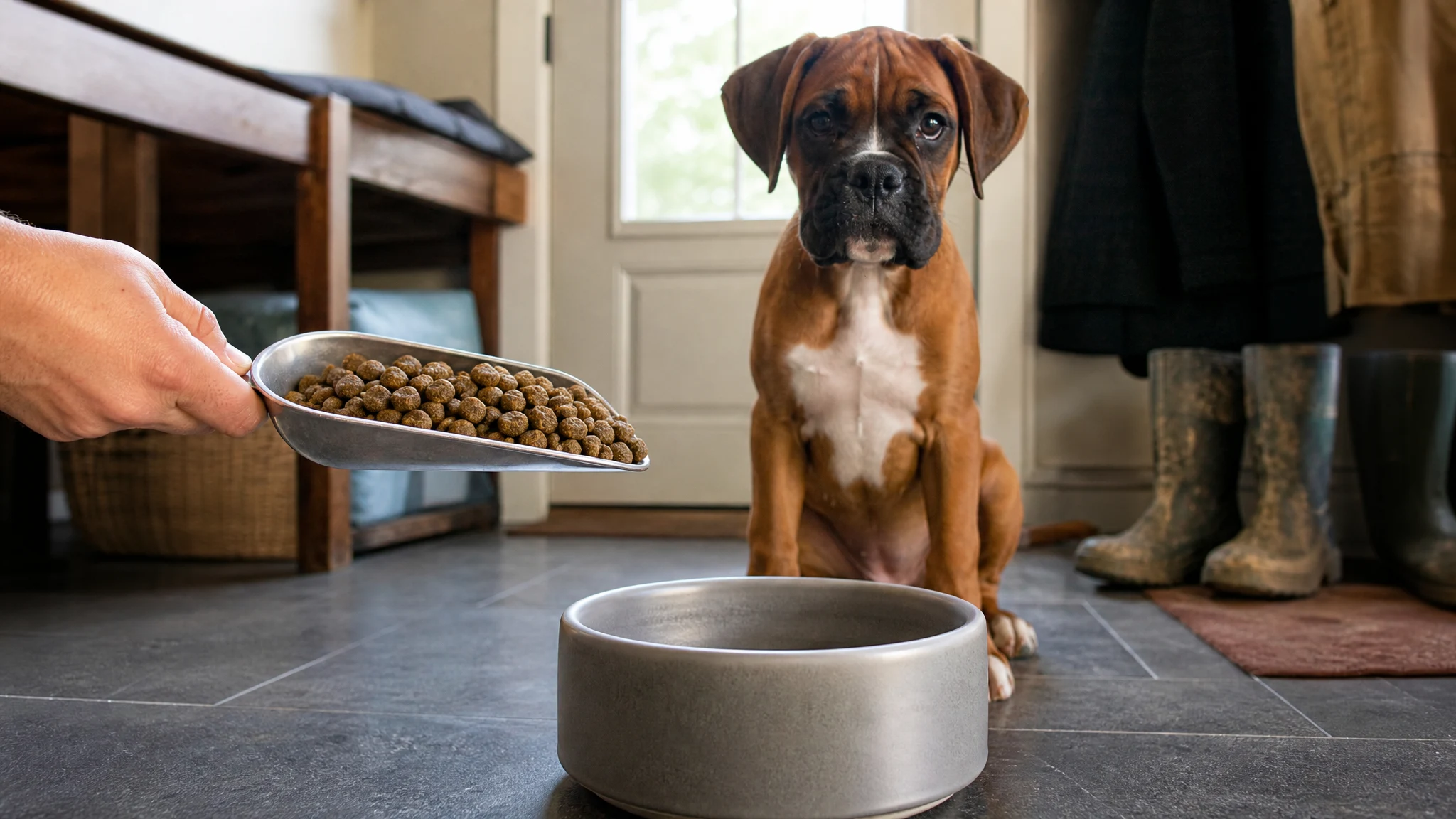
General nutrition information compiled from product labels and published sources, not veterinary advice. Your veterinarian is the right person to choose a diet for your dog, especially one with a health condition.
Most owners want one simple boxer puppy feeding chart with a weight in one column and cups in the other. The trouble is that cups depend on the food. A cup of one kibble can hold about 100 more calories than a cup of another. A chart that ignores that is a guess.
This guide shows how to build your own chart from the feeding table on your puppy's food label. It also covers how to set meals and adjust them. For a broader look at amounts across life stages, see our Boxer feeding chart by age and weight.
What this method is, and what it is not
We compared label data from the brands' own pages. We did not run feeding trials or taste tests, and we have not fed these foods to dogs. The numbers below are what the manufacturers print, shown as starting points. They are not prescriptions.
I also could not find a published Boxer puppy cups-per-day table from a Boxer-specific source. Royal Canin's Boxer formula page covers adult Boxers 15 months and older. So the amounts have to come from the label of the food you choose.
Materials you will need
- The bag or can of the puppy food, with its feeding table and nutritional adequacy statement
- A standard dry measuring cup, or a kitchen scale for weighing portions
- A notebook or phone note for weights and portions
- A scale you can use to weigh your puppy, such as a baby scale or a vet clinic scale
- A slow feeder bowl set on the floor (see step 5)
Step 1: Check that the food suits a growing Boxer
Look for the small print called the nutritional adequacy statement. Foods for growth or all life stages must say whether they meet the AAFCO profile "including" or "except for" the growth of large-size dogs, which means dogs of 70 pounds or more as adults, according to Whole Dog Journal's explainer on adequacy statements.
Boxers sit near that line. PetMD lists adult Boxers at about 65 to 80 pounds, so many males land at or above 70. A Boxer puppy can be fed a food whose label says "including growth of large-size dogs." That is a reasonable thing to look for, not a rule. If a label says "except for growth of large-size dogs," it is not meant for large-breed puppies, so ask your veterinarian before using it.
Two examples from the brands' own labels:
- VICTOR Elite Canine states all life stages, including growth of large size dogs.
- VICTOR Hi-Pro Plus states all life stages, except for growth of large size dogs.
The Hill's Science Diet Puppy Large Breed Chicken & Brown Rice Recipe is made for large-breed puppies up to 18 months. Its page statement says it provides complete and balanced nutrition for growing puppies. Check the brand's page for the exact wording on large-size growth.
Step 2: Find the calories in a cup
Calories per cup tell you how concentrated a food is. These are the figures the brands list for a few foods that mention large-size growth or puppies:
| Food | Label calories | Label note |
|---|---|---|
| Hill's Science Diet Puppy Large Breed (dry) | 387 kcal per cup | Large-breed puppies up to 18 months |
| VICTOR Elite Canine (dry) | 386 kcal per cup | All life stages, including large-size growth |
| Nom Nom Chicken Cuisine (fresh) | 244 kcal per cup | Page lists all life stages including large-size growth |
Do not swap cups between foods. If you change brands, rebuild your chart from the new label.
Step 3: Read the label's feeding table and build your chart
Most puppy labels give amounts by the dog's weight, and some also by age. The Hill's large-breed puppy page, for example, uses a chart by weight and age band, from under 4 months up to 13 to 18 months. Copy the rows that match your puppy's current weight and age into your notebook.
- Weigh your puppy.
- Find the matching row on the label.
- Write down the daily cups, then divide by the number of meals.
- Re-weigh on a regular schedule and update the row.
Your own chart will look like this, with the numbers filled in from the label:
| Puppy weight today | Label daily cups | Meals per day | Cups per meal |
|---|---|---|---|
| (from your scale) | (from the label) | (from your vet or label) | (daily cups divided by meals) |
For scale, here are adult examples from labels, which show how widely the amounts vary by food. Hill's Science Diet Adult Large Breed lists 3 1/4 cups a day for a 50 lb dog and 5 1/3 cups for 100 lb. Royal Canin Boxer Adult lists 2 7/8 cups a day for a 53 lb dog at its Activity + level. These are adult amounts and should not be used for a puppy.
Step 4: Set the meal schedule
Labels differ on frequency. VICTOR's Elite Canine page says puppies are fed as much as they eat in 20 minutes, in four feedings a day. Other brands give a daily total only. Ask your veterinarian how many meals suit your puppy at each age.
As your Boxer grows, you will likely move toward fewer meals. PetMD advises two meals a day about 12 hours apart for Boxers because of bloat (GDV) risk. Your vet can tell you when that switch makes sense for your dog.
Step 5: Serve in a way that suits Boxers
PetMD's Boxer page also advises against raised food bowls and suggests slow feeder bowls. Put the bowl on the floor. Pick up leftovers after the meal.
Keep hard play away from mealtimes. The sources we reviewed give no timing rule for this, so ask your veterinarian what they advise.
Step 6: Adjust by body condition, not only by the label
Label guides are starting points. Hill's says to adjust amounts to maintain optimal weight. You should be able to feel the ribs under a thin layer of padding. Your vet can show you how to score body condition at a checkup.
The reason to watch this is that PetMD flags excess weight as a joint-strain concern for Boxers. A published literature review in the Canadian Veterinary Journal (Tal et al., 2018) also links excess energy during growth to rapid growth and developmental orthopedic disease in large-breed puppies. That is why steady, measured portions matter more than a full bowl.
Step 7: Plan the move to adult food
There is no Boxer-specific switch age in the sources we found. PetMD says to ask the vet. The Kennel Club (UK) says dogs over about 57 lb (26 kg) reach adulthood between 15 months and 2 years. That is a general rule for larger dogs, not a Boxer rule.
When you switch, do it gradually. Hill's suggests a 7-day transition, and Freshpet suggests 10 days for its fresh recipe. Rebuild your chart from the adult food's label.
Tips
- Count treats and training rewards in the day's total.
- Weigh kibble with a scale if cup sizes vary. A heaping cup can add a lot.
- Keep one feeder in the house so amounts do not double up.
- Write the weight and portion down each time you change it.
Common mistakes to avoid
- Using an adult chart for a puppy. Adult tables are built for a different life stage.
- Choosing a food marked "except for growth of large size dogs" without asking. Boxers are borderline for the 70 lb cutoff, so check with your vet.
- Reading the bag by the dog's future weight. Use your puppy's weight today.
- Feeding to a clean-bowl rule. A hungry puppy is not proof that it needs more.
- Treating food as a heart or joint fix. PetMD gives no diet cure for ARVC, and the American Boxer Club's health page gives no specific diet advice for hip dysplasia.
What to expect
Following a label guide and adjusting by body condition may help your puppy grow at a steady pace and stay lean. It may also make mealtimes more predictable. Results vary from dog to dog, and no food can promise a particular outcome.
If your Boxer has a health condition, a poor appetite, loose stools, or a weight that is climbing or dropping, confirm amounts with your veterinarian before changing anything. Only a veterinarian prescribes therapeutic diets. The FDA has said it has not found a definitive diet link to non-hereditary DCM, so ask your vet about heart concerns rather than switching foods on your own.
Sources
- PetMD Boxer breed page
- American Boxer Club health page
- Tal et al., Can Vet J 2018 (PMC5731398)
- The Kennel Club (UK), Puppy food to adult food
- Whole Dog Journal, In the Fine Print: Nutritional Adequacy Statements
- FDA CVM, Questions and Answers on non-hereditary DCM in dogs
- Hill's Pet Nutrition, Puppy Large Breed product page
- VICTOR Pet Food, Elite Canine product page
- Royal Canin US, Boxer Adult product page