Boxer Puppy Feeding Schedule: Meals by Age
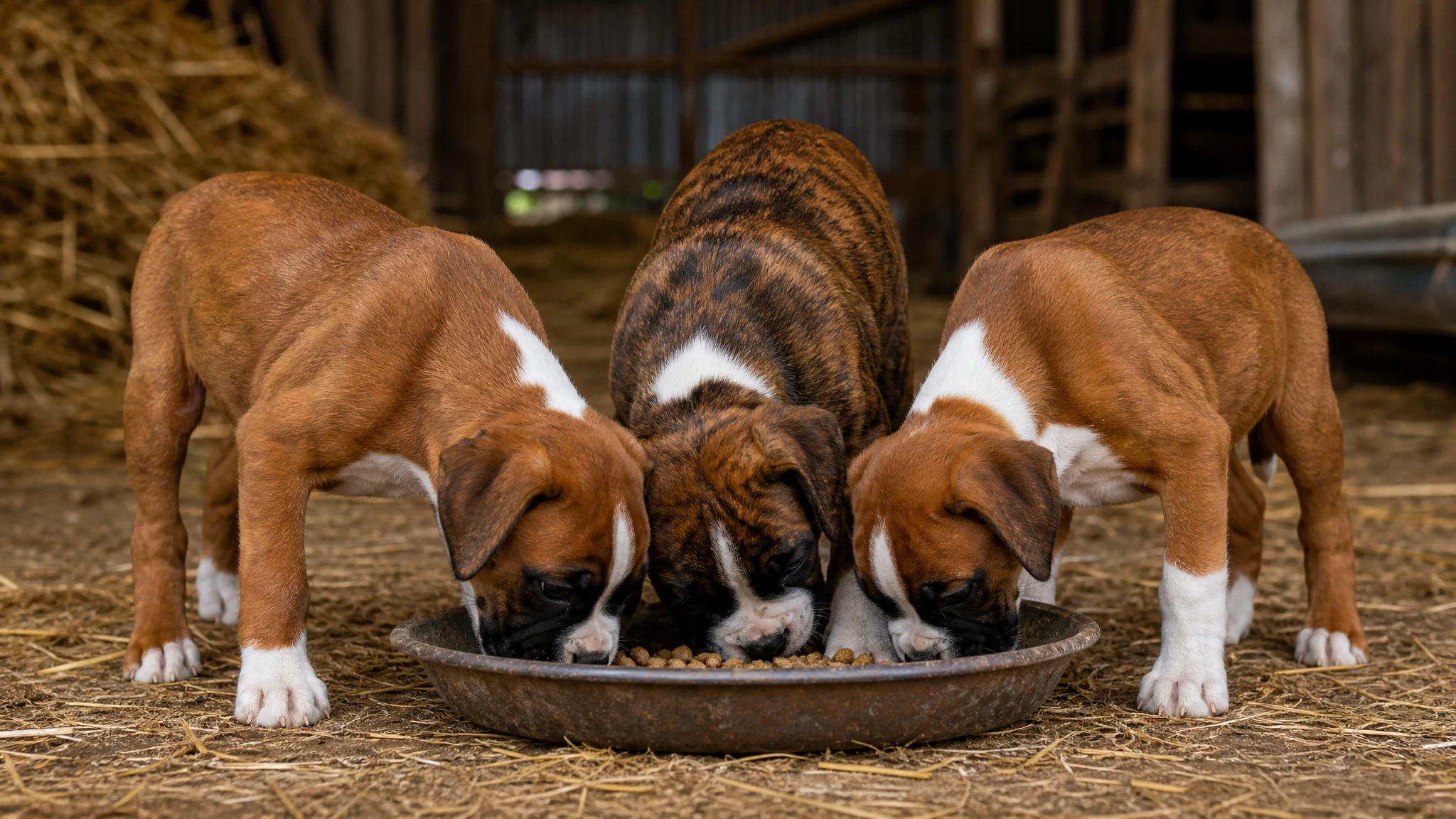
General nutrition information compiled from product labels and published sources, not veterinary advice. Your veterinarian is the right person to choose a diet for your dog, especially one with a health condition.
A good boxer puppy feeding schedule is mostly about three things: the right food, steady meal times, and amounts you adjust as your puppy grows. This guide walks through each step and is honest about what the sources do and do not say.
One caution first. We found no published Boxer-specific chart that says how many meals to feed at each week of age. Where a number is not available, this page says so and points you to your veterinarian or the food brand.
What You Need
- A complete and balanced puppy food, or an all life stages food that fits your puppy (see Step 1).
- A set of measuring cups and a kitchen scale, if you want to weigh portions.
- A slow feeder bowl, which PetMD's Boxer page suggests for the breed's bloat risk.
- A floor-level bowl. PetMD advises against raised food bowls for Boxers.
- A simple notebook or phone note to log meals, weight and stool quality.
- The feeding guide printed on your chosen food's bag or brand page.
Step 1: Read the Adequacy Statement
Start with the small print on the bag. Foods for growth or all life stages must say whether they meet the nutrient profile "including" or "except for" growth of large-size dogs. Whole Dog Journal explains that large-size means 70 pounds or more as an adult. "Including" means the food is formulated for large-breed puppies. "Except for" means it is not.
Boxers sit near that line. PetMD lists adult Boxers at about 65 to 80 pounds. So a Boxer puppy can reasonably be fed a food whose label says "including growth of large-size dogs." That is not a requirement, and no Boxer-specific calcium guidance was found. A review of the literature in the Canadian Veterinary Journal (Tal et al., 2018) links excess energy and excess calcium during growth to developmental orthopedic disease in large-breed puppies. That is a reason to measure portions, not to guess.
Examples of how labels read:
- The VICTOR Elite Canine page gives an all life stages statement that includes growth of large-size dogs.
- The VICTOR Hi-Pro Plus page gives an all life stages statement that excludes growth of large-size dogs. That wording means it is not meant for large-breed puppy growth, so check with your vet before using it for a Boxer puppy.
- The Hill's Science Diet Puppy Large Breed page lists the food for large breed puppies up to 18 months.
These are examples of label wording, not recommendations. We compared label data only. We did not run feeding trials or taste tests.
Step 2: Choose Your Meal Count by Stage
Here is what the sources support, stage by stage.
| Stage | What the sources say | What to do |
|---|---|---|
| Young puppy | The VICTOR label for its puppy-suitable foods says puppies eat as much as they will in 20 minutes, in four feedings a day. | Ask your vet whether four meals suits your puppy. Follow the guide for your chosen food. |
| Growing puppy | Hill's puts its large breed puppy chart by weight and age band, from under 4 months to 13 to 18 months. | Find your puppy's weight and age band on the brand's chart and use it as a starting point. |
| Near adult size | The Kennel Club (UK) says dogs over about 57 pounds reach adulthood between 15 months and 2 years. This is a general rule for larger dogs, not Boxer-specific. | Ask your vet when to switch. PetMD gives no switch age for Boxers. |
| Adult | PetMD advises two meals a day about 12 hours apart for Boxers. | Move to two spaced meals once your vet says your dog is ready for adult food. |
The table does not give a meal count for every month. That is deliberate. Sources do not agree on one, and your vet can tailor it to your puppy's weight and health.
Step 3: Set the Daily Amount From the Label
Label feeding guides are starting points. They depend on weight and age, and sometimes on activity level. Hill's tells owners to adjust amounts to maintain optimal weight. The adult guides vary a lot between foods because calories per cup differ. For example, the VICTOR Elite Canine page lists 386 kcal per cup, while the Hill's puppy page lists 387 kcal per cup. A cup of one food is not a cup of another.
- Weigh your puppy.
- Find that weight and age on the feeding guide of your food.
- Write down the daily total.
- Divide it by the number of meals you chose in Step 2.
- Measure each meal the same way every time.
For a deeper look at portions, see our Boxer feeding chart by age and weight.
Step 4: Set Fixed Meal Times
Pick times that fit your day and keep them steady. Offer the bowl, wait a set time, then pick up what is left. VICTOR's label uses 20 minutes for puppies, which is one reasonable window.
Use a slow feeder bowl on the floor. PetMD names bloat (GDV) as a Boxer concern and recommends spaced meals, no raised bowls and slow feeders. No food has been shown to prevent bloat, so treat these as habits to discuss with your vet.
Quiet time after meals is also a common sense habit. Ask your vet what they advise for your puppy.
Step 5: Switch Foods Slowly
When you change foods, do it over several days. Hill's says to transition its puppy food over 7 days. VICTOR's Senior Healthy Weight page says 7 to 10 days. Freshpet's page says 10 days. Mix a little of the new food into the old, then shift the ratio each day.
If your puppy has loose stools or refuses food during the change, slow down and call your vet.
Step 6: Plan the Move to Adult Food
Do not pick a date out of the air. The Kennel Club (UK) describes adulthood as arriving between 15 months and 2 years for dogs over about 57 pounds. Royal Canin's Boxer Adult page describes its breed formula for purebred Boxers 15 months and older, and lists an AAFCO maintenance statement. Hill's lists its large breed puppy food up to 18 months.
Those ranges overlap, but they are not identical. Ask your vet for the right month for your own puppy, then use the 7 to 10 day switch from Step 5.
Step 7: Check Weight and Adjust
PetMD links excess weight to joint strain in Boxers. The Tal et al. review also ties excess energy in growth to rapid growth and orthopedic problems in large-breed puppies. So track weight, not just bowl size.
- Weigh your puppy on a regular schedule and write it down.
- Compare the number to the food's chart and to your vet's advice.
- Count treats and training rewards as part of the day's food.
- Change amounts in small steps, not big jumps.
Common Mistakes to Avoid
- Copying an adult amount. Adult guides and puppy guides differ. Use the puppy guide for your food.
- Using a food that says "except for growth of large size dogs." Boxers are borderline for the 70 pound cutoff, so check with your vet before choosing one.
- Free feeding all day. It hides how much your puppy eats and makes weight harder to manage.
- Trusting cups across brands. Calories per cup differ, so the same cup can mean a different amount of energy.
- Adding supplements on your own. Complete puppy foods are meant to be balanced. Ask your vet before adding anything.
- Assuming marketing equals fit. "Breed" or "premium" on the front means little. The adequacy statement on the back matters more.
Health Conditions and Your Vet
PetMD notes that Boxers can develop ARVC, a heart condition, and says Boxers need quality protein for healthy muscles, including the heart. It gives no diet cure for ARVC. The American Boxer Club health page says diet and conditioning cannot be ruled out as factors in hip dysplasia, but it gives no specific diet advice. It gives no diet advice for chronic kidney disease either.
On DCM, the FDA says it has not found a definitive diet link to non-hereditary DCM and has not asked for any recalls. It also says it does not know the specific connection between certain diets and cases. If your puppy has any health condition, a veterinarian decides the food and the amounts. Prescription diets are only something a vet prescribes.
What to Expect
With steady meals and measured portions, many owners find mealtimes become more predictable. A puppy fed a suitable complete food and weighed regularly may be more likely to grow at a steady pace and stay in a healthy body condition. No feeding plan can promise a particular result, since growth also depends on genetics, activity and health.
Boxers typically live 10 to 12 years, according to PetMD, so the habits you build now are worth getting right. Review your plan with your vet at puppy visits.
Sources
- PetMD Boxer breed page
- American Boxer Club health page
- The Kennel Club (UK), Puppy food to adult food
- Tal et al., Canadian Veterinary Journal 2018 (PMC5731398)
- Whole Dog Journal, In the Fine Print: Nutritional Adequacy Statements
- FDA CVM, Questions and Answers on Non-Hereditary DCM in Dogs
- VICTOR Pet Food, Elite Canine
- Hill's Pet Nutrition, Puppy Large Breed
- Royal Canin US, Boxer Adult