How Much Food Should a Boxer Eat: A Weight-Based Guide
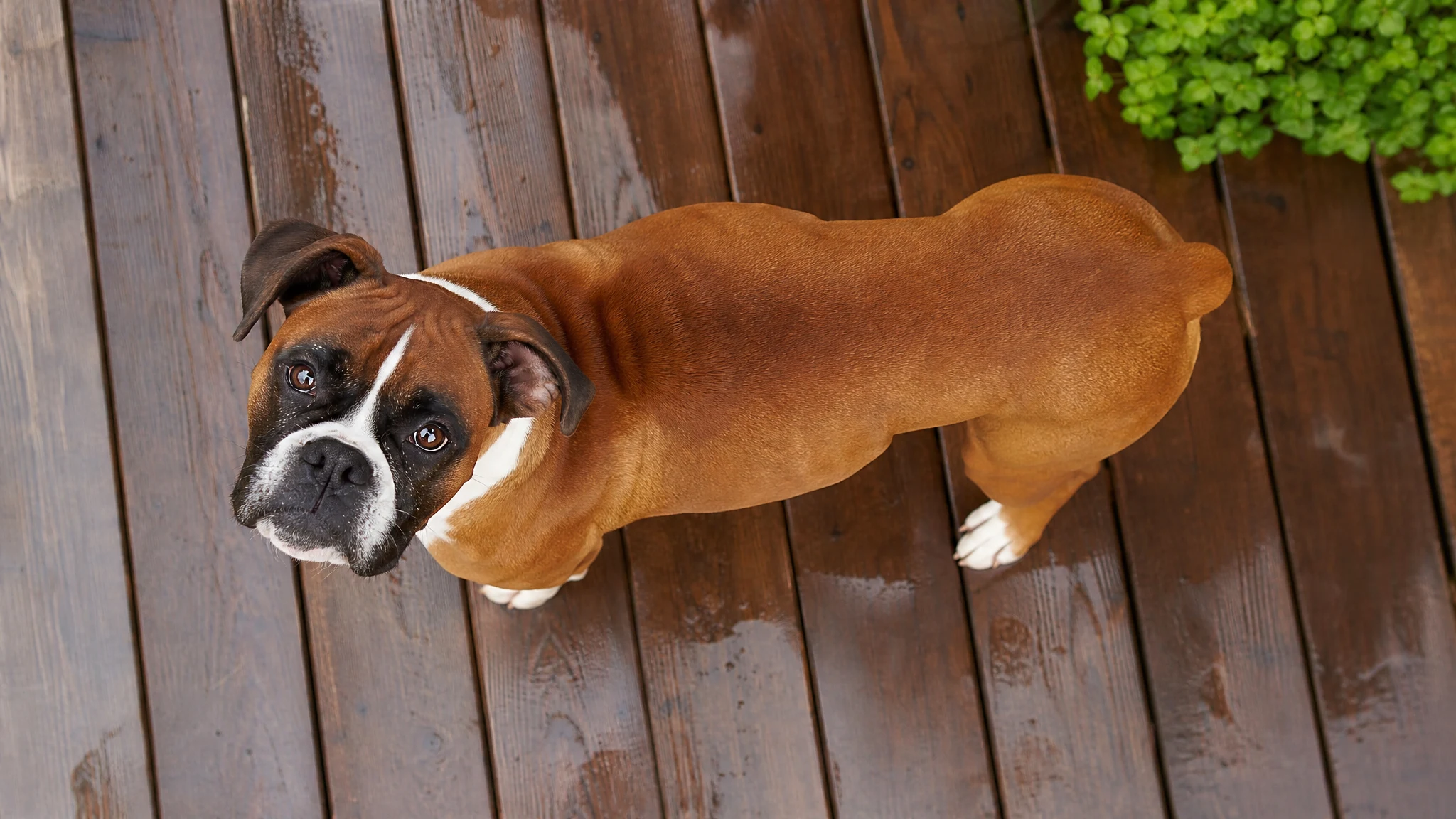
General nutrition information compiled from product labels and published sources, not veterinary advice. Your veterinarian is the right person to choose a diet for your dog, especially one with a health condition.
If you are asking how much food should a Boxer eat, the honest answer starts with the bag in your hands. Every food has a different calorie density, so a cup of one food is not a cup of another. The label guide, your dog's weight and your dog's body condition all matter more than a single number.
This guide walks through the steps for setting a daily amount. It uses label examples as starting points only. We compared label data from brand pages. We did not run feeding trials or taste tests.
What You Need
- A scale that can weigh your dog (a home scale works if you weigh yourself holding the dog, then subtract your own weight, or ask your vet clinic to weigh your dog).
- The bag or the brand's product page for your dog's food.
- A standard dry measuring cup, or a kitchen scale for grams.
- A slow feeder bowl set on the floor.
- A notebook or phone note to log weight and portions.
Know the Size You Are Feeding For
The PetMD Boxer breed page lists adult Boxers at about 65 to 80 pounds and calls the breed medium in size. It gives a life expectancy of 10 to 12 years. That puts many adult Boxers between the example weights printed in feeding charts, so you will often read between two lines.
For a table of amounts organized by age, see our Boxer feeding chart by age and weight. The steps below show you how to build your own number from the food you actually buy.
Step-by-Step: Setting a Daily Amount
Step 1: Weigh your dog and write it down
Use today's weight, not the weight you hope for or the weight from the last vet visit. Feeding guides are written by body weight, so a wrong weight gives a wrong starting point.
Step 2: Decide the life stage
Puppy, adult and senior foods are built differently. The Kennel Club (UK) says dogs over about 57 pounds (26 kg) reach adulthood between 15 months and 2 years. That is a general rule for larger dogs, not a Boxer-specific rule. PetMD gives no set switch age for Boxers and advises asking your vet. So treat the move from puppy food to adult food as a question for your vet, not a birthday.
Step 3: Read the nutritional adequacy statement
Look for the AAFCO statement on the bag. It tells you which life stage the food is built for. For puppies, the wording about large-size dogs matters. Whole Dog Journal explains that growth and all-life-stages foods must say whether they meet the profile "including" or "except for" growth of large-size dogs (70 pounds or more as an adult).
A Boxer is borderline for that 70-pound line, since males run 65 to 80 pounds per PetMD. A Boxer puppy can be fed a food whose label says "including growth of large-size dogs." That is not a requirement. It is a reasonable label to look for, and your vet can confirm the fit.
Step 4: Find your dog's weight in the brand's feeding guide
Every brand publishes its own guide. Use the brand's own page or the bag, because the amounts differ with calorie density. A few examples from brand pages show how much the numbers move:
| Food (brand page) | Calories listed | Label example |
|---|---|---|
| Royal Canin Boxer Adult dry | 335 kcal ME per cup, calculated | 53 lb dog at the Activity + level: 2 7/8 cups (253 g) per day |
| Hill's Science Diet Adult Large Breed Chicken & Barley dry | 365 kcal per cup | 50 lb dog: 3 1/4 cups per day; 100 lb dog: 5 1/3 cups per day |
| VICTOR Elite Canine dry | 386 kcal per cup | On an 8 oz cup: 1 1/4 cups for 15 lb, 5 1/8 cups for 100 lb |
These are not recommendations for your dog. They show that the same dog could be offered different cup amounts depending on the food. The Royal Canin guide also separates dry and mixed feeding and adjusts by activity level. Hill's tells owners to adjust amounts to maintain optimal weight.
Brand pages: Royal Canin Boxer Adult, Hill's Science Diet Adult Large Breed, VICTOR Elite Canine.
Step 5: Read between the lines for your dog's weight
If your Boxer weighs 70 pounds and the chart lists 50 and 100, you are somewhere in between. Start near the middle, then watch your dog. Charts assume an average dog. A calm house dog and a daily jogging partner of the same weight may need different amounts, which is why activity level appears on some guides.
Step 6: Split the daily amount into two meals
PetMD advises two meals a day about 12 hours apart for Boxers because of bloat (GDV) risk. It also advises against raised food bowls and suggests slow feeder bowls. Divide the daily amount in half and feed it in two measured servings.
Food does not prevent bloat, and no diet is claimed to. These are handling habits the source recommends. Ask your vet what bloat signs to watch for.
Step 7: Measure every meal
Scoop and level the cup, or weigh in grams if the guide lists grams, as Royal Canin does. A heaping scoop can add a noticeable extra amount over a month. Use the same measuring cup the guide was written for. VICTOR's chart, for example, is based on an 8 oz cup.
Step 8: Check your dog every two to four weeks and adjust
Weigh your dog again and note how the body looks and feels. Ask your vet to show you how to score body condition so you are not guessing. If weight creeps up, trim the daily amount a little and recheck. Small changes are easier to judge than big ones.
When you switch foods, do it slowly. Hill's lists a 7-day transition for its puppy food, VICTOR lists 7 to 10 days for Senior Healthy Weight, and Freshpet lists 10 days. Check the brand page for the food you are using.
Puppies: Growth Needs Careful Pacing
A literature review in the Canadian Veterinary Journal (Tal et al., 2018) links excess energy and excess calcium during growth to developmental orthopedic disease in large-breed puppies. It also notes that excess energy promotes rapid growth. No Boxer-specific calcium guidance turned up, so ask your vet about it instead of guessing.
In practice, that means measured meals and no free feeding for a growing Boxer. Some puppy guides, like VICTOR's, describe feeding as much as the puppy eats in 20 minutes over four feedings. Hill's Science Diet Puppy Large Breed lists a chart by weight and age band up to 18 months. Whichever guide you use, watch growth with your vet instead of pushing for the fastest gain.
Tips for Better Results
- Count treats. Treats and chews add calories, so trim meals if treats go up.
- Compare calories, not cups. Wet and fresh foods differ widely. Hill's canned Chicken & Barley lists 369 kcal per 13 oz can, and Freshpet's Home Cooked Chicken lists 189 kcal per cup. Do not swap cup for cup between formats.
- Keep a log. A weight note every few weeks shows trends you would otherwise miss.
- Watch excess weight. PetMD flags excess weight and joint strain as a concern for the breed.
- Use the label as a starting point. The guide is a first estimate, not a verdict on your dog.
Common Mistakes to Avoid
- Feeding by the cup size you happen to own instead of the cup the guide uses.
- Using a food that says "except for growth of large size dogs" for a Boxer puppy without asking your vet. VICTOR Hi-Pro Plus carries that wording, for example.
- Leaving food out all day, which makes portions impossible to track.
- Raising the bowl on a stand, which PetMD advises against.
- Changing foods and amounts at the same time, so you cannot tell which change caused a result.
- Assuming a grain-free or boutique food needs less or more. Read the calories and the label.
A Note on Heart Health and Diet
Boxers are prone to a heart condition called ARVC, and PetMD says Boxers need quality protein for healthy muscles, including the heart. It gives no diet cure for ARVC, and neither do we. The FDA says it has not found a definitive diet link to non-hereditary DCM and has not asked for any recalls. It counted 1,382 DCM reports from January 1, 2014 to November 1, 2022, and says it does not know the specific connection between these diets and cases of non-hereditary DCM. If your Boxer has a heart diagnosis, your vet decides the diet.
What to Expect
If the amount suits your dog, you may see steady weight, regular stools and a consistent appetite over the next several weeks. Results vary by dog, and a food or portion change does not promise any health outcome. If your Boxer has a health condition, is a puppy or senior, or is gaining or losing weight, confirm amounts with your veterinarian before you change anything. A vet decides what is right for an individual dog, including any prescription diet.
The American Boxer Club health page covers hip dysplasia and kidney disease but gives no specific diet advice, so do not rely on a food to manage either one.
Sources
- PetMD Boxer breed page
- American Boxer Club health page
- The Kennel Club (UK), Puppy food to adult food
- Tal et al., Can Vet J 2018;59(1):36-42
- FDA CVM, Questions and Answers on non-hereditary DCM in dogs
- Whole Dog Journal, In the Fine Print: Nutritional Adequacy Statements
- Royal Canin Boxer Adult product page
- Hill's Science Diet Adult Large Breed product page
- VICTOR Elite Canine product page