How Much to Feed a 3-Month-Old Boxer Puppy
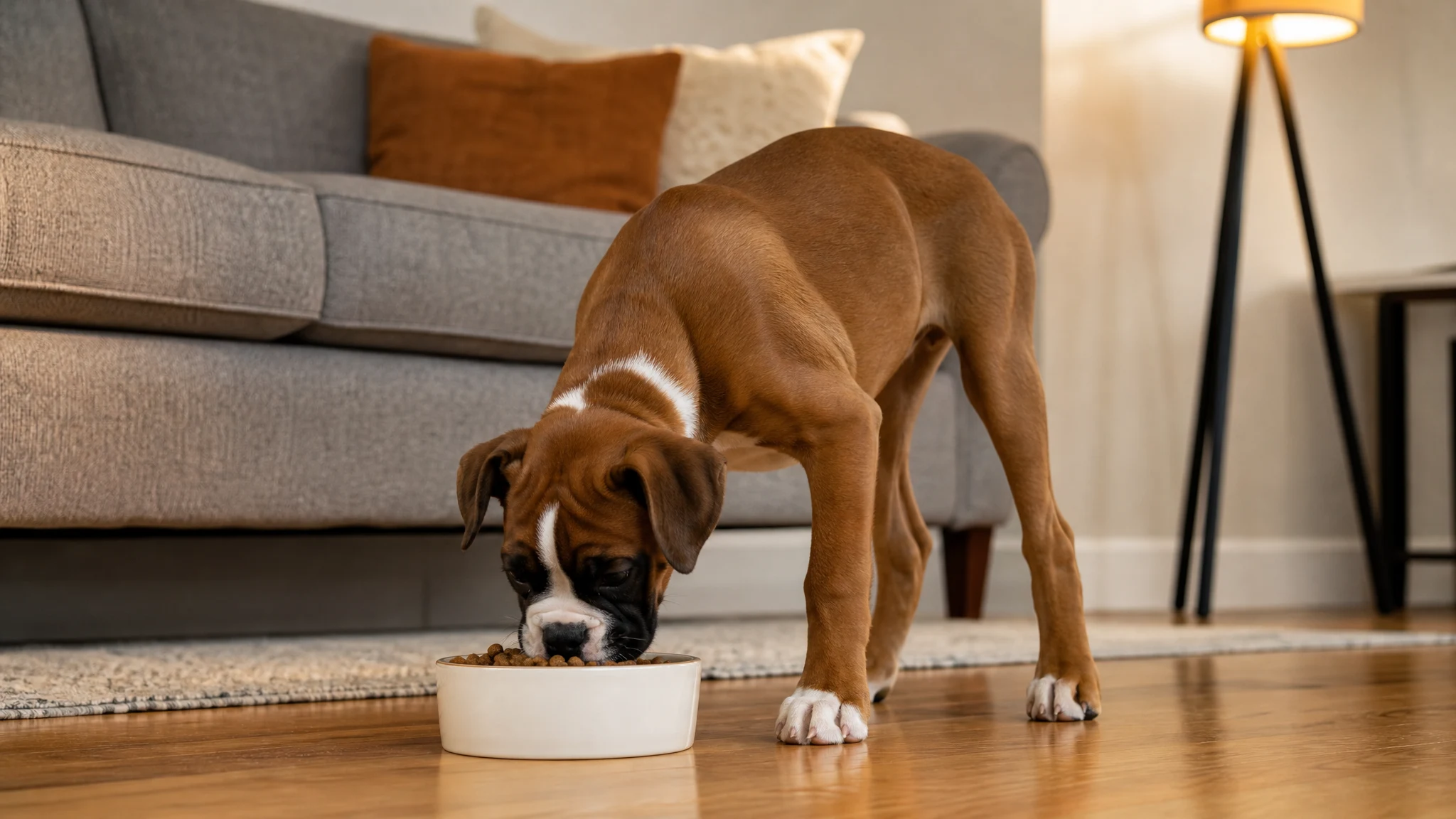
General nutrition information compiled from product labels and published sources, not veterinary advice. Your veterinarian is the right person to choose a diet for your dog, especially one with a health condition.
There is no single cup measure that fits every Boxer puppy at 12 weeks. The right amount depends on the food you pick, your puppy's current weight, and how active they are. A vet decides what is right for an individual dog.
What you can do is use the feeding guide on your puppy food's label as a starting point, then adjust with your vet. This page walks through that process step by step.
Adult Boxers are about 65 to 80 pounds, according to the PetMD Boxer breed page. A puppy has a lot of growing to do, so the goal at this age is steady, not rapid, growth.
What You Need
- The bag or can your puppy is eating, with the label in front of you.
- A standard measuring cup, or a kitchen scale if the label gives grams.
- A scale that can weigh your puppy, such as a home scale (weigh yourself holding the puppy, then subtract) or the one at your vet's office.
- A notebook or phone note to track weight, meals and stool.
- A slow feeder bowl, if your vet agrees it suits your puppy.
- Your vet's phone number, for questions about amounts.
How We Compared Foods
We compared label data from each brand's own page. We did not run feeding trials or taste tests, and we have not fed any of these foods to dogs. Where a brand page did not list a number, we say so and suggest you check with the brand.
Step 1: Choose a Food Labeled for Growth
Start with the nutritional adequacy statement on the label. For a puppy, it should say the food is formulated for growth or for all life stages.
Boxers sit close to a line on the label. According to Whole Dog Journal's explanation of AAFCO statements, foods for growth or all life stages must say whether they meet the profile "including" or "except for" growth of large-size dogs, meaning dogs of 70 pounds or more as adults. Male Boxers are listed at 65 to 80 pounds, so many fall near that cutoff.
A Boxer puppy can be fed a food whose label says "including growth of large-size dogs." That is not a rule, and no Boxer-specific calcium guidance turned up. Ask your vet which label wording they prefer for your puppy.
Do not use an adult food just because it is made for Boxers. The Royal Canin Boxer Adult dry food, for example, is described on Royal Canin's US page for purebred Boxers 15 months and older. We did not find a Royal Canin Boxer puppy product, so check with the brand if you wonder about one.
Step 2: Read the Label's Feeding Guide
Every label has a starting point. Here is what a few brand pages say, so you can see how different they are.
| Food | Label statement on growth | Calories | Puppy feeding note from the brand page |
|---|---|---|---|
| VICTOR Elite Canine (dry) | All life stages, including growth of large size dogs (70 lb or more as an adult) | 386 kcal per cup | Puppies fed as much as they eat in 20 minutes, four feedings a day |
| Hill's Science Diet Puppy Large Breed Chicken & Brown Rice (dry) | Complete and balanced nutrition for growing puppies; the page for large-size wording should be checked | 387 kcal per cup | Chart by weight and age band; adjust to maintain optimal weight; transition over 7 days |
| VICTOR Hi-Pro Plus (dry) | All life stages, except for growth of large size dogs | 406 kcal per cup | Puppies eat as much as they will in 20 minutes, four feedings |
Notice that two foods with similar calories per cup still give different guidance. One uses a weight and age chart. The other uses a timed meal. This is why a universal number for "a 3 month old" would mislead you.
Also notice the Hi-Pro Plus statement. It says "except for" growth of large size dogs, which means the brand does not label it for large-breed puppies. Given where Boxers fall on size, ask your vet before choosing a food with that wording.
For a breed-wide look at amounts as your dog grows, see our Boxer feeding chart by age and weight.
Step 3: Find Your Puppy's Row on the Chart
Weigh your puppy today. Then find the matching weight and age band in the label's chart. If your puppy is between two rows, note both amounts.
Write down the total for the whole day. The chart usually gives a daily total, not a per-meal amount.
If your label gives only a timed approach, as the VICTOR page does for puppies, use that as written. Measure what your puppy actually eats and record it, so you know the real amount.
Step 4: Split the Day Into Meals
Divide the daily total into equal meals. The VICTOR product pages, for instance, describe four feedings a day for puppies. Other brands may suggest a different number, so follow your food's label and your vet's advice.
PetMD's Boxer page advises two meals a day about 12 hours apart for Boxers, and also advises avoiding raised food bowls and using slow feeder bowls because of bloat (GDV) risk. That advice is written for the breed in general, not for a puppy at a given age. Ask your vet when your puppy should move from several small meals to two, and keep the meals calm and unhurried.
Step 5: Measure Every Meal
Level the cup. Do not scoop heaped or guess. A heaped cup of a food at around 386 calories per cup can add a meaningful amount over a day.
If you feed canned or fresh food, check the unit. Some brand pages list calories per can or per pack, not per cup. For example, VICTOR's canned pate lists calories per can, and its label says it is for growth and maintenance except large size growth. Fresh foods vary in the same way, so check the brand page for puppy suitability.
Step 6: Track Weight and Body Shape
Weigh your puppy on a regular schedule, and write it down. You should be able to feel the ribs under a thin layer of padding without them standing out sharply.
Excess energy during growth promotes rapid growth and developmental orthopedic disease in large-breed puppies, according to a literature review published in the Canadian Veterinary Journal (Tal et al., 2018). The PetMD Boxer page also lists excess weight and joint strain among its concerns. Slow, steady gain is the aim.
The label's own guide says to adjust to maintain optimal weight. If the scale or your hands tell you your puppy is gaining too fast or looks thin, call your vet before changing the amount.
Step 7: Change Foods Slowly
If you switch foods, mix the new food in gradually. The Hill's puppy page describes a 7-day transition. Other brands give different schedules, so follow the one on your label.
Tips
- Count treats and training rewards as part of the day's food. Use small pieces.
- Pick up the bowl after the meal so you know what was eaten.
- Use the same measuring cup every time.
- Keep notes on stool. Changes after a food switch are worth mentioning to your vet.
- Keep fresh water available.
- Recheck the label chart as your puppy's weight changes. Do not stay on the same amount for weeks without weighing.
Common Mistakes
- Using an adult formula for a puppy. Check the adequacy statement for growth.
- Treating the chart as a rule. The label is a starting point. Activity, weight and your vet's advice matter.
- Free feeding. It makes amounts impossible to track.
- Adding supplements on your own. Extra calcium in particular is a topic for your vet. We do not give supplement amounts.
- Rushing growth. Bigger sooner is not better for a growing large-size dog.
- Switching foods too fast. Follow the transition guide on the label.
What to Expect
If the food and amount suit your puppy, you may see steady weight gain, a visible waist, regular stools and good energy between meals. These signs can differ from dog to dog, and no feeding plan can promise a result.
Food does not prevent or treat any condition. For example, PetMD names ARVC (Boxer cardiomyopathy) as a breed concern, and notes Boxers need quality protein for healthy muscles, including the heart, but it gives no diet cure. The American Boxer Club health page says diet and conditioning cannot be ruled out as factors in hip dysplasia, and gives no specific diet advice.
On the question of heart disease and diet, the FDA says it has not found a definitive diet link to non-hereditary DCM and has not asked for any recalls. It also says it does not know the specific connection between the diets it looked at and cases of non-hereditary DCM. Talk with your vet about what that means for your puppy.
When to Call Your Vet
Ask your vet to confirm amounts if your puppy has a health condition, is gaining or losing weight in a way that worries you, refuses meals, or has ongoing stool or stomach trouble. Prescription diets come only from a veterinarian.
Bring your notes and the food label to the visit. That makes it easy to adjust the plan together.
Sources
- PetMD Boxer breed page
- American Boxer Club health page
- Tal et al., Canadian Veterinary Journal 2018 (PMC5731398)
- Whole Dog Journal, In the Fine Print: Nutritional Adequacy Statements
- FDA, Questions and Answers: FDA's Work on Potential Causes of Non-Hereditary DCM in Dogs
- VICTOR Elite Canine product page
- VICTOR Hi-Pro Plus product page
- Hill's Science Diet Puppy Large Breed product page
- Royal Canin Boxer Adult product page