How Much to Feed a 6-Month-Old Boxer
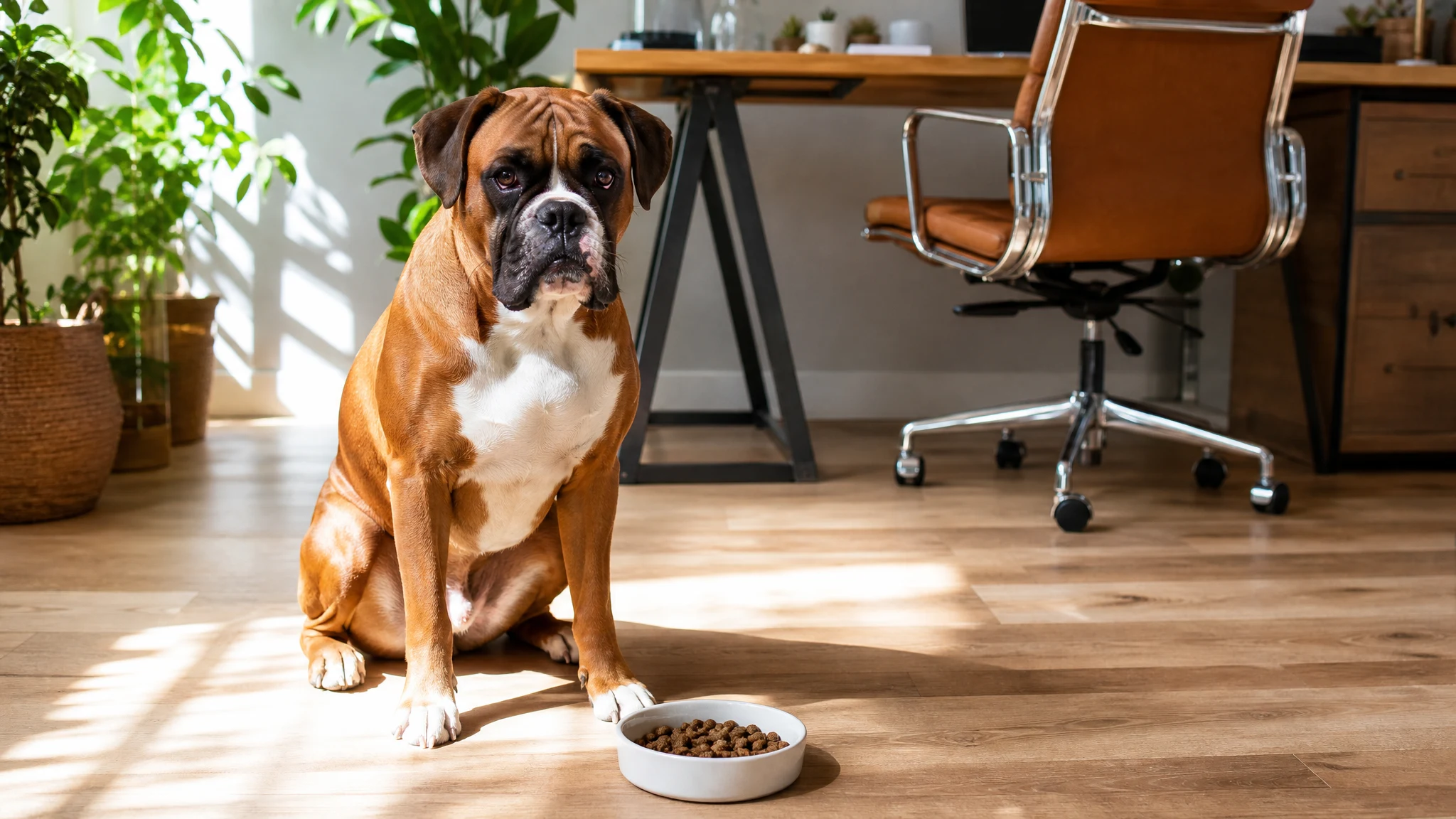
General nutrition information compiled from product labels and published sources, not veterinary advice. Your veterinarian is the right person to choose a diet for your dog, especially one with a health condition.
At six months, a Boxer puppy is growing fast and eating like it. Many owners ask how much to feed a 6 month old Boxer, and the honest answer is that no single number fits every dog. The right amount depends on the food, the puppy's current weight, and how active the puppy is.
This guide shows how to find a sensible starting amount from the food label, how to split it into meals, and how to adjust it. For amounts across other ages, see the Boxer feeding chart by age and weight.
What to know before you start
PetMD lists adult Boxers at about 65 to 80 pounds, with a medium size category. A six-month-old is well short of that. PetMD does not give a switch age from puppy to adult food for Boxers and says to ask your vet.
For a general rule, The Kennel Club (UK) says dogs over about 57 pounds reach adulthood between 15 months and 2 years. That is a rule for larger dogs, not a Boxer-specific figure. It does suggest your Boxer will likely stay on a growth-appropriate food for a good while longer.
We compared label data from manufacturer pages for this article. We did not run feeding trials or taste tests, so nothing here is a ranking of foods.
Materials you need
- The bag or can of the food you feed, with its feeding chart and nutritional adequacy statement
- A kitchen scale or a standard measuring cup (not a scoop of unknown size)
- A scale to weigh your puppy, or a vet clinic visit for a weigh-in
- A slow feeder bowl, set on the floor
- A notebook or phone note to log weight and amounts
Step 1: Check that the food suits a growing Boxer
Look for the adequacy statement on the label. Foods for growth or all life stages must say whether they meet the profile "including" or "except for" growth of large-size dogs, which are dogs expected to reach 70 pounds or more as adults, according to Whole Dog Journal's explanation of AAFCO labeling. "Including" means formulated for large-breed puppies. "Except for" means it is not.
Male Boxers can reach 65 to 80 pounds, so they sit right at that 70 pound line. A Boxer puppy can reasonably be fed a food whose label says "including growth of large-size dogs." This is not a requirement, and your vet can advise on your puppy.
Here is how a few labels read:
| Food | Label statement on large-size growth | Energy listed |
|---|---|---|
| VICTOR Elite Canine (dry) | All life stages, including growth of large size dogs | 386 kcal per cup |
| Hill's Science Diet Puppy Large Breed Chicken & Brown Rice (dry) | Made for large breed puppies up to 18 months; the adequacy statement says it is for growing puppies, so check the bag for the large-size wording | 387 kcal per cup |
| VICTOR Hi-Pro Plus (dry) | All life stages, except growth of large size dogs | 406 kcal per cup |
Royal Canin's Boxer Adult formula is made for purebred Boxers 15 months and older, so it is not a six-month food. Check with the brand about any puppy option.
Step 2: Weigh your puppy
Feeding charts run on body weight, so start with a real number. Weigh your puppy on a home scale, or ask your vet clinic for a weigh-in. Write down the date and weight.
Do not use the adult weight range from a breed page as your puppy's weight. Chart rows are for the dog in front of you today.
Step 3: Find the starting amount on the label
Find your puppy's weight and age band on the manufacturer's chart. Hill's, for example, publishes a puppy chart by weight and age band, running from under 4 months up to 13 to 18 months. Match the row for your puppy's current weight and age.
Treat the number as a starting point. Hill's itself says to adjust amounts to maintain optimal weight. Charts also differ by brand because the foods differ in energy. Two foods can have similar calories per cup (387 and 386 above), while a richer food like Hi-Pro Plus at 406 kcal per cup packs more energy into each scoop.
If you feed fresh or canned food, the chart units differ. Freshpet lists calories per cup, but canned products such as Hill's and VICTOR list calories per can. Do not swap cups and cans.
Step 4: Split the daily amount into meals
Divide the daily total into the number of meals the label or your vet suggests. Labels vary. VICTOR's puppy directions for its dry foods call for four feedings a day, with puppies eating as much as they will in 20 minutes. That approach is quite different from a measured amount, so ask your vet which method fits your Boxer.
For bloat (GDV), PetMD advises Boxers to eat two meals a day about 12 hours apart, to avoid raised food bowls, and to use slow feeder bowls. That advice is written for Boxers in general, not puppies in particular. Ask your vet how to set up meals for a six-month-old, and when to move to fewer, larger meals.
Whatever the schedule, keep meal times steady and measure every portion.
Step 5: Watch the body, not just the bowl
Check your puppy every week or two. Run your hands along the ribs. You should be able to feel them without pressing hard, and you should see a waist from above. If you cannot feel ribs, the puppy may be getting too much. If ribs and hip bones stand out sharply, ask your vet.
This matters because a review of the literature in Tal et al. (Canadian Veterinary Journal, 2018) links excess energy during growth to rapid growth and developmental orthopedic disease in large-breed puppies. That review was within a case report, and it does not say what to do for an individual Boxer. A lean, steady growth pattern is the goal, and your vet can judge it.
Step 6: Adjust in small steps
If your puppy is gaining too fast or looks heavy, trim the amount a little and recheck in a week or two. If your puppy looks thin and is always hungry, raise it a little. Do not make big jumps.
PetMD also notes that excess weight adds joint strain for Boxers, which is another reason to keep portions measured. Count treats and training rewards toward the day's food.
Tips
- Switch foods slowly. Hill's suggests a 7 day transition for its puppy food, and Freshpet suggests 10 days for its fresh recipe.
- Use the same measuring cup every time. A dog scoop can hold much more than one cup.
- Log weight every two weeks. A trend is more useful than one reading.
- Feed in a calm spot, with a slow feeder bowl on the floor.
- Keep fresh water out all day.
Common mistakes to avoid
- Using an adult food chart. Adult formulas are made for maintenance, not growth.
- Choosing a food that says "except for growth of large size dogs" without checking. The VICTOR Hi-Pro Plus label notes Boxers are usually under 70 pounds, but a male may not be. Ask your vet first.
- Free feeding with a full bowl all day. It makes portions impossible to track.
- Treating the label as a rule. It is a starting point.
- Adding supplements on your own. Ask your vet before adding anything, including calcium. We found no Boxer-specific calcium guidance, so check with your vet.
- Believing a food will protect against a disease. No food is shown to prevent hip dysplasia, heart disease or bloat. The American Boxer Club health page says diet and conditioning cannot be ruled out as factors in hip dysplasia, but it gives no specific diet advice.
A note on heart health and grain-free talk
Boxers are known for ARVC, sometimes called Boxer cardiomyopathy. PetMD says Boxers need quality protein for healthy muscles, including the heart, but it gives no diet cure for ARVC.
On the separate question of diet-linked DCM, the FDA says it has not found a definitive link between diet and non-hereditary DCM and has not asked for any recalls. Its Q&A also says it does not know the specific connection between certain diets and cases. For a Boxer with any heart concern, your vet decides the diet.
What to expect
If you measure portions, weigh regularly and adjust slowly, your puppy may keep a steady, lean growth pattern. You may also notice more consistent stools and fewer begging episodes, although every dog differs. These are not promised outcomes.
Check with your vet about amounts if your puppy has a health condition, a digestive problem, or is gaining or losing weight in a way that worries you. For a dog with any condition, confirm amounts and the food itself with your vet before changing anything. Prescription diets come only from a veterinarian.
Quick recap
- Pick a food whose label suits growing large-size dogs, and confirm with your vet.
- Weigh your puppy and write it down.
- Find the matching weight and age row on the label chart.
- Split the amount into meals as your vet advises, using a slow feeder.
- Check ribs and waist every week or two.
- Adjust in small steps and log changes.
Sources
- PetMD Boxer breed page
- American Boxer Club health page
- The Kennel Club (UK), Puppy food to adult food
- Tal et al., Canadian Veterinary Journal 2018
- Whole Dog Journal, In the Fine Print: Nutritional Adequacy Statements
- FDA, Questions and Answers on non-hereditary DCM in dogs
- Hill's Science Diet Puppy Large Breed product page
- VICTOR Elite Canine product page
- VICTOR Hi-Pro Plus product page
- Royal Canin Boxer Adult product page