Boxer Nutrition: The Diet Factors That Matter for This Breed
General nutrition information compiled from product labels and published sources, not veterinary advice. Your veterinarian is the right person to choose a diet for your dog, especially one with a health condition.
Boxer nutrition comes down to a handful of decisions: the right life stage food, a sensible calorie level, a meal routine that suits a deep-chested dog, and honest label reading. This guide walks through each one in order.
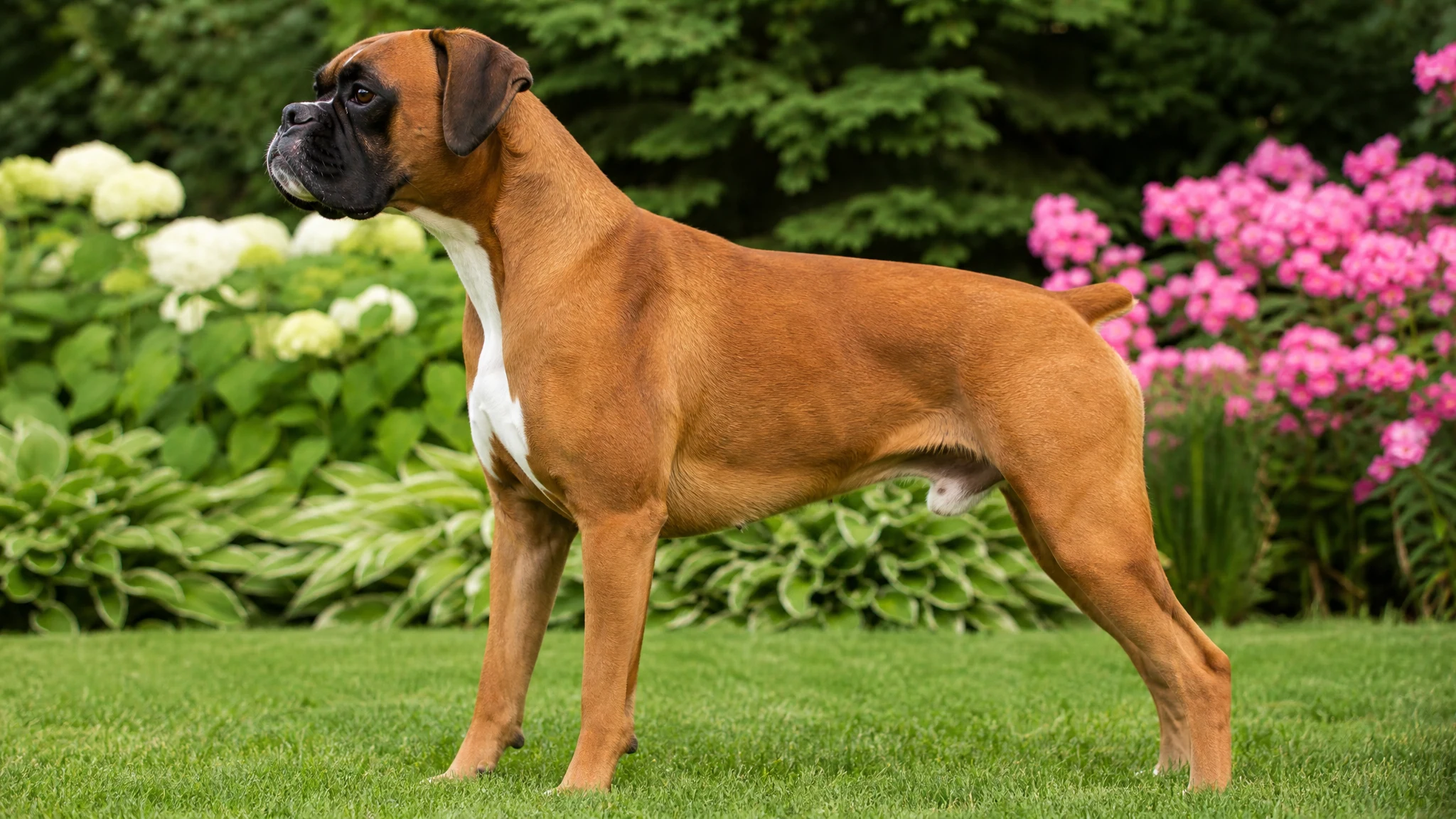
The Boxer is a medium dog. PetMD lists adults at about 65 to 80 pounds and 21 to 25 inches tall, with a life expectancy of 10 to 12 years. That size sits near an important label cutoff for puppies, which we cover in Step 2.
One caution first. No food on this page prevents, treats or cures any condition. Where a health topic comes up, we report what the source says about diet and leave individual decisions to your veterinarian.
How we compared foods
We compared label data from the brands' own product pages: the nutritional adequacy statement, the first five ingredients, the analysis numbers and calories. We did not run feeding trials or taste tests, and we did not feed any of these foods to dogs. Label data cannot tell you how a particular dog will do on a food.
Materials you will need
- Your dog's current weight and age, and the latest weight your vet recorded.
- The bag, can or pack label of any food you are considering, or the brand's own product page.
- A kitchen scale or a standard measuring cup (cup sizes differ between brands, so use the same cup each time).
- A slow feeder bowl, as PetMD suggests for Boxers.
- A notebook for weight, meals and treats.
- Your veterinarian's contact details, because several steps end with "ask the vet."
Step 1: Know what your Boxer's diet has to account for
Start with the health topics that touch diet. Here is what each source says, and what it leaves out.
Heart disease (ARVC)
PetMD lists ARVC, often called Boxer cardiomyopathy, as a breed concern. The same page says Boxers need quality protein for healthy muscles, including the heart. It gives no diet cure for ARVC, so do not treat a food choice as heart protection. Heart screening and monitoring are vet decisions.
Bloat (GDV)
PetMD advises two meals a day about 12 hours apart, no raised food bowls, and slow feeder bowls. That is meal management rather than a particular recipe. Step 6 turns it into a routine.
Excess weight and joint strain
PetMD links extra weight with strain on joints in Boxers. This is the area where you have the most day-to-day control, through calories and portions.
Hip dysplasia
The American Boxer Club health page says that other factors, such as diet and conditioning, cannot be ruled out as influences. It gives no specific diet advice. Take that as a reason to keep your dog lean and fit, and to ask your vet about anything more.
Chronic kidney disease
The American Boxer Club health page lists chronic kidney disease but gives no diet advice. If your vet ever raises kidney concerns, any diet change is a veterinary decision. Prescription diets are something only a veterinarian prescribes.
The DCM question
You may have read about diet and dilated cardiomyopathy (DCM). The FDA's Q&A page (content current as of 08/19/2024) says the agency has not found a definitive diet link to non-hereditary DCM and has not asked for any recalls. It counted 1,382 DCM reports from January 1, 2014 to November 1, 2022. The FDA also says it does not know the specific connection between these diets and cases of non-hereditary DCM. Its main investigation page says it will not release further public updates until there is meaningful new scientific information.
That is not a reason to panic or to switch foods on your own. It is a reason to ask your vet if you have questions about your dog's heart and diet.
Step 2: Pick the right life stage
Puppies
A review in the Canadian Veterinary Journal (Tal et al., 2018) links excess energy and excess calcium during growth to developmental orthopedic disease in large-breed puppies. It also says excess energy promotes rapid growth. We found no Boxer-specific calcium guidance, so ask your vet about your puppy's growth rate and food.
AAFCO labeling matters here. According to Whole Dog Journal, foods labeled for growth or all life stages must say whether they meet the profile "including" or "except for" growth of large-size dogs, meaning dogs of 70 pounds or more as adults. "Including" means the food is formulated for large-breed puppies. "Except for" means it is not.
Male Boxers run 65 to 80 pounds, so the breed straddles that 70 pound line. A Boxer puppy can be fed a food whose label says "including growth of large-size dogs." This is an option, not a requirement. Your vet can say which fits your puppy.
When to switch to adult food
PetMD gives no switch age for Boxers and says to ask the vet. The UK Kennel Club says dogs over 26 kg (about 57 lb) reach adulthood between 15 months and 2 years. That is a general rule for larger dogs, not a Boxer-specific one, but it shows why a switch at 12 months may be early for some Boxers.
Adults and seniors
Adult maintenance foods are labeled for adult dogs. Senior formulas vary a great deal between brands, so read the label rather than the word "senior." Brands also set their own age ranges. For example, Hill's lists its Adult Large Breed food for dogs 1 to 5 years, and Royal Canin describes its Boxer Adult for purebred Boxers 15 months and older.
Step 3: Read the adequacy statement
Find the sentence that begins "formulated to meet" or "animal feeding tests ... substantiate." It tells you which life stage the food is complete and balanced for. Check three things:
- Does it say maintenance, growth, or all life stages?
- If it says growth or all life stages, does it say "including" or "except for" large-size dogs?
- Does it rest on a formulation or on feeding tests? Both are valid AAFCO routes, and neither is a guarantee about your dog.
Some examples from the brands' own pages:
- VICTOR Elite Canine states all life stages, including growth of large size dogs.
- VICTOR Hi-Pro Plus states all life stages, except for growth of large size dogs. If you have a growing Boxer puppy, that wording is worth a conversation with your vet.
- Royal Canin Boxer Adult states maintenance only.
- Hill's Science Diet Puppy Large Breed is for large breed puppies up to 18 months. Check the brand page for its exact adequacy wording before relying on it for a Boxer puppy.
Step 4: Compare the label data side by side
Write down the first five ingredients, the protein and fat numbers, and the calories for each food. Note that the first five ingredients show what the label lists in order of weight, not how good the food is. Marketing terms such as "premium" or "natural" are not nutrition data.
A few examples of what the brands publish:
| Food (brand page) | Label statement | Protein / fat min. | Calories |
|---|---|---|---|
| Royal Canin Boxer Adult (dry) | Maintenance | 24% / 18% | 335 kcal ME per cup, calculated |
| Hill's Science Diet Adult Large Breed Chicken & Barley (dry) | Maintenance, feeding tests | Dry matter averages only (23.8% / 15%) | 365 kcal per cup |
| VICTOR Elite Canine (dry) | All life stages, including large-size growth | 25% / 14% | 386 kcal per cup |
| VICTOR Senior Healthy Weight (dry) | Adult maintenance | 27% / 11.5% | 360 kcal per cup |
| Freshpet Home Cooked Chicken (fresh) | Adult maintenance | 15% / 11% | 189 kcal per cup, calculated |
Do not compare these columns blindly. Hill's publishes dry matter averages rather than guaranteed minimums, so its numbers are not the same kind of figure as Royal Canin's. Fresh and canned foods contain water, so their percentages look lower without meaning less protein per calorie. Per-cup calories also depend on the cup, so only compare foods measured the same way.
Kibble size was not listed for most of these foods. If kibble size matters to you, check with the brand.
Step 5: Match calories to your dog
Calorie density is how much energy sits in each cup. The dry foods above range from 335 to 386 kcal per cup. The difference is about 50 calories per cup, which adds up across a day of meals.
To use it:
- Find the feeding chart on the brand's page and locate your dog's weight.
- Treat that amount as a starting point. Hill's, for instance, says to adjust amounts to maintain optimal weight.
- Weigh the food or use one measuring cup every time.
- Count treats and chews as part of the day's food, and reduce meals to match.
- Weigh your dog every two to four weeks and write it down.
Chart examples show how much amounts vary. Royal Canin lists 2 7/8 cups (253 g) per day for a 53 pound dog at its higher activity level. Hill's Adult Large Breed lists 3 1/4 cups per day for a 50 pound dog. These differ because the foods differ in calories and the charts use different activity assumptions. This is why the chart on your own bag matters more than any number quoted elsewhere.
If your dog is gaining or losing weight, adjust in small steps and tell your vet. A weight reduction plan is a vet conversation, not a guess.
Step 6: Build a bloat-aware meal routine
Follow the PetMD guidance directly:
- Split the day's food into two meals about 12 hours apart.
- Use a slow feeder bowl.
- Do not use a raised food bowl.
Divide the daily amount from Step 5 by two. Do not double the amount at one meal to make up for a missed one. PetMD gives no further bloat rules on that page, so ask your vet about exercise timing and warning signs. Bloat is an emergency, and a vet should tell you what to watch for.
Step 7: Change foods slowly
Brands suggest gradual transitions. Hill's Puppy Large Breed lists 7 days, VICTOR Senior Healthy Weight lists 7 to 10 days, and Freshpet lists 10 days. A common approach is to mix a little of the new food into the old and increase the share every couple of days. Follow the instructions on the new food's label.
If your dog has ongoing stomach trouble, stop the change and call your vet.
Step 8: Review with your vet
Bring your notebook and the food label to checkups. Ask about body condition, growth rate for puppies, when to move to adult food, and anything related to the heart, joints or kidneys. Your vet decides what is right for an individual dog.
Tips
- Keep one change at a time. If you switch food, treats and routine all at once, you cannot tell what caused a result.
- Fresh and refrigerated foods have storage rules. Freshpet, for example, says to use its product within 7 days of opening.
- Check the brand's own page for current labels, because formulas and wording can change.
- If you are curious about fresh or cooked foods, look for a statement that they are complete and balanced for your dog's life stage, not just a list of whole ingredients. Nom Nom and JustFoodForDogs describe their products as meeting AAFCO profiles, but quote the full statement from their pages and confirm it covers large-size growth if you have a puppy.
Common mistakes to avoid
- Switching to adult food too early. Use your vet's advice, not a fixed birthday.
- Ignoring "except for." An all life stages food that excludes large-size growth may not suit a growing Boxer. Ask your vet.
- Feeding by the bag chart alone. Charts are starting points, and your dog's weight trend is the real feedback.
- Counting only meals. Treats add up quickly for a medium dog.
- Using a raised bowl. PetMD advises against it.
- Assuming a grain-free or breed-named label solves a health concern. Neither is shown by the sources here to protect against heart disease or anything else.
- Adding supplements on your own. Ask your vet before giving any, including doses.
What to expect
If you choose a food that matches your dog's life stage and manage portions, many owners see steady energy, a healthy weight trend and regular stools within a few weeks. Results vary by dog. Weight changes are gradual, and a change in coat or stool can reflect many things besides food.
Nothing here can promise a result for heart, hip, kidney or any other health topic. The sources say diet is one factor to discuss with your vet, and for several of these conditions they give no diet advice at all.
Sources
- PetMD Boxer breed page
- Westminster Kennel Club breed page
- American Boxer Club health page
- Tal et al., Can Vet J 2018;59(1):36-42
- FDA CVM, Questions and Answers on non-hereditary DCM in dogs
- FDA investigation page on diets and canine DCM
- The Kennel Club (UK), Puppy food to adult food
- Whole Dog Journal, In the Fine Print: Nutritional Adequacy Statements
- Royal Canin Boxer Adult product page
- Hill's Science Diet Adult Large Breed product page
- VICTOR Elite Canine product page
- Freshpet Home Cooked Chicken Recipe product page