Grain-Free Food and Boxers: What the FDA DCM Investigation Found
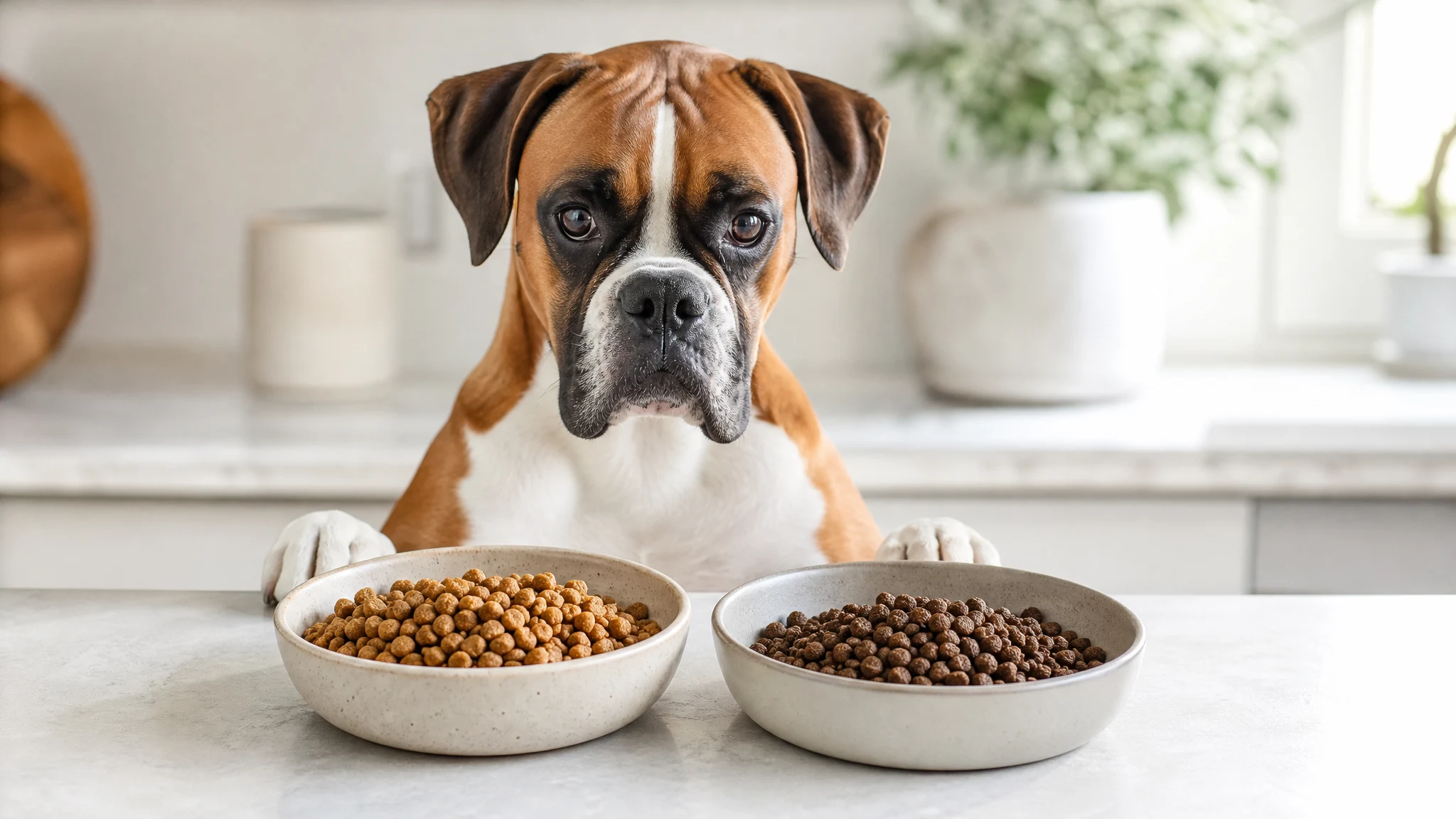
General nutrition information compiled from product labels and published sources, not veterinary advice. Your veterinarian is the right person to choose a diet for your dog, especially one with a health condition.
Many Boxer owners have heard that grain free dog food might harm the heart. Boxers already have a heart condition they are known for, so the worry makes sense. The news is also confusing, because the story is still unsettled.
This guide walks you through the question step by step. You will see what the FDA has said, what it has not said, and how to check your own dog's food label. It cannot tell you whether any one food is right for your dog. A veterinarian decides that.
What You Need Before You Start
- The bag or can your Boxer eats now, or a photo of the full label.
- The ingredient list and the nutritional adequacy (AAFCO) statement from that label.
- Your Boxer's current weight, age, and any health notes from past vet visits.
- Any records of heart screening, if your dog has had it.
- A pen and paper for questions to bring to your veterinarian.
Step 1: Understand What the FDA Is Actually Investigating
The FDA's Center for Veterinary Medicine has been looking at a possible link between certain diets and non-hereditary dilated cardiomyopathy (DCM) in dogs. DCM is a disease in which the heart muscle weakens and the heart has trouble pumping blood.
The word "non-hereditary" matters. The FDA's focus is on DCM in dogs that are not from breeds or family lines with a known genetic tendency for it. The agency did not start by asking whether grain free dog food is bad for every dog. It started with reports of heart disease in dogs eating certain kinds of diets.
In its Questions and Answers page on non-hereditary DCM, the FDA counted 1,382 DCM reports from January 1, 2014 to November 1, 2022. That page was current as of August 19, 2024.
Step 2: Learn What the FDA Has and Has Not Concluded
This is the step where most headlines go wrong. Here is what the FDA says in its own words.
- The FDA has not found a definitive link between diet and non-hereditary DCM.
- The FDA has not requested any recalls.
- In the same Q&A, the agency states: "The FDA does not know the specific connection between these diets and cases of non-hereditary DCM."
So when you ask "is grain free bad for Boxers," the honest answer from the FDA material is that the cause is not established. The agency has not said that grain free diets are proven to cause DCM. It has also not cleared them.
A report count is also not the same as a diagnosis rate. It tells you cases were reported, not how many dogs eat any given food.
Step 3: Check How Current the Information Is
The FDA's main investigation page was last updated on December 23, 2022. On that page the agency says: "FDA does not intend to release further public updates until there is meaningful new scientific information to share."
The agency's earlier public update on the topic came on February 19, 2019. That means the grain free dog food DCM question has been open for years without a final answer.
A quiet FDA page does not mean the question is solved. It means the agency has nothing new to report. If you read a claim that sounds certain, either way, check it against the FDA pages listed in the Sources below.
Step 4: Separate Boxer Heart Disease From the FDA Investigation
Boxers are named for a heart condition on their own. PetMD's Boxer breed page lists ARVC, often called Boxer cardiomyopathy, among the breed's health concerns. That is a different question from the FDA's non-hereditary DCM investigation, which is about diet.
Here is what the sources do and do not say:
- PetMD lists ARVC as a Boxer health concern.
- PetMD also says Boxers need quality protein for healthy muscles, including the heart.
- PetMD gives no diet cure for ARVC, and no food should be described as one.
- The FDA material reviewed here does not state a Boxer-specific DCM risk from grain free diets. If you want to know whether the agency has said more about a breed, check the FDA pages directly or ask your veterinarian.
For a Boxer owner, this means two separate conversations with the vet: the breed's own heart screening, and what is in the food bowl.
Step 5: Read Your Dog's Food Label
Now look at the food itself. You are collecting facts to bring to the vet, not making a verdict.
- Find the nutritional adequacy statement. It says whether the food is complete and balanced and for which life stage. A statement such as "formulated to meet the nutritional levels established by the AAFCO Dog Food Nutrient Profiles for maintenance" tells you the life stage.
- Read the first five ingredients. Ingredients are listed by weight. Note the protein source and what carbohydrate source follows it, such as rice, barley, oats, peas, or potatoes.
- Look for the words "grain free." Some foods say it on the front. Others simply do not list grains. Check the ingredient list rather than relying on the front of the bag.
- Write down the guaranteed analysis. Note the minimum protein and fat and the maximum fiber.
- Check the calories. Calories per cup or per can help your vet compare foods. Brands publish this on their own product pages.
For example, Royal Canin's Boxer Adult dry food lists brown rice, brewers rice, chicken fat, chicken by-product meal, and oat groats as its first five ingredients. Its label data lists 24% minimum protein, 18% minimum fat, and 335 kcal per cup. You can see that on the Royal Canin product page. That is a grain-inclusive example, shown only so you know what label data looks like.
We compared label data from brand pages. We did not run feeding trials or taste tests, and label data cannot show how a food will work for your dog.
Step 6: Match the Food to Your Boxer's Life Stage
A label that suits an adult may not suit a puppy. Boxers usually weigh about 65 to 80 pounds as adults, according to PetMD. That puts them near the AAFCO line for "large-size dogs," which is 70 pounds or more as an adult.
Whole Dog Journal explains that foods labeled for growth or all life stages must say whether they meet the profile "including" or "except for" growth of large-size dogs. For a Boxer puppy, a food whose label says "including growth of large-size dogs" is one that can be fed. It is not a rule that it must be.
For adult timing, PetMD gives no switch age for Boxers and says to ask the vet. The Kennel Club (UK) notes that dogs over about 57 pounds reach adulthood between 15 months and 2 years, though that is a general rule for larger dogs and not specific to Boxers.
Step 7: Make a List of Questions for Your Veterinarian
Bring your notes to an appointment. Good questions include:
- Given my Boxer's age and health history, is the current food a good fit?
- Should my dog have heart screening, and how often?
- Does the FDA's DCM work change anything for my dog?
- If we switch foods, how should we make the change?
- How many meals a day and what bowl type suit my dog?
On the last point, PetMD advises two meals a day about 12 hours apart, no raised food bowls, and slow feeder bowls for Boxers, because of bloat (GDV) risk. Your vet can confirm what fits your dog.
Step 8: Change Food Only With a Plan
If your vet suggests a change, do it gradually. Brands publish their own switching guidance. For instance, VICTOR suggests a transition over 7 to 10 days for its Senior Healthy Weight food, and Hill's lists a 7 day transition for its large breed puppy food. Follow the plan on the new food's own page and your vet's advice.
Do not stop a prescribed diet on your own. Prescription diets are something only a veterinarian prescribes.
Tips for Boxer Owners
- Keep the bag or a photo. If a question comes up later, the lot and label details help your vet.
- Read the primary source. The FDA pages are short and plain. Social media summaries often add certainty the agency did not.
- Watch your dog's weight. PetMD lists excess weight as a strain on joints. Feeding guides on labels are starting points, and your vet can adjust them.
- Tell your vet about treats and toppers. They are part of the diet too.
- Use the brand's own page for label details. Ingredients and analysis can change, so check the current page.
Common Mistakes to Avoid
- Switching suddenly out of fear. A fast change can upset digestion. A plan with your vet is calmer.
- Assuming "grain free" equals risky, or "with grain" equals safe. The FDA has not drawn that line, and it says it does not know the specific connection.
- Treating a food as a heart cure. No source here supports a food that prevents or treats ARVC or DCM.
- Ignoring the life stage. A food marked "except for growth of large size dogs" is not meant for large-breed puppies. VICTOR Hi-Pro Plus carries that wording, so check the label if a Boxer puppy is involved.
- Relying on supplements without advice. Ask your vet before adding anything to the bowl.
- Forgetting regular check-ups. Heart disease in dogs is found through exams, not label reading.
What to Expect From This Process
After these steps, you should have a clear picture of what is known and unknown. You will have your dog's label details organized and a list of questions for the vet.
Your vet may suggest keeping the current food, changing it, or doing heart screening. Those outcomes depend on your dog, and nothing here can promise a result. Diet is one part of care. Boxers can still develop heart problems from genetic causes whatever they eat, and the FDA says it has not found a definitive diet link.
If the FDA publishes new findings, the agency's pages are the place to look first. Until then, a steady relationship with your veterinarian is the most practical safeguard you have.
Sources
- FDA CVM, Questions and Answers: FDA's Work on Potential Causes of Non-Hereditary DCM in Dogs
- FDA investigation into a potential link between certain diets and canine dilated cardiomyopathy
- FDA update, February 19, 2019
- PetMD Boxer breed page
- American Boxer Club health page
- Whole Dog Journal, In the Fine Print: Nutritional Adequacy Statements
- The Kennel Club (UK), Puppy food to adult food
- Royal Canin US, Boxer Adult product page