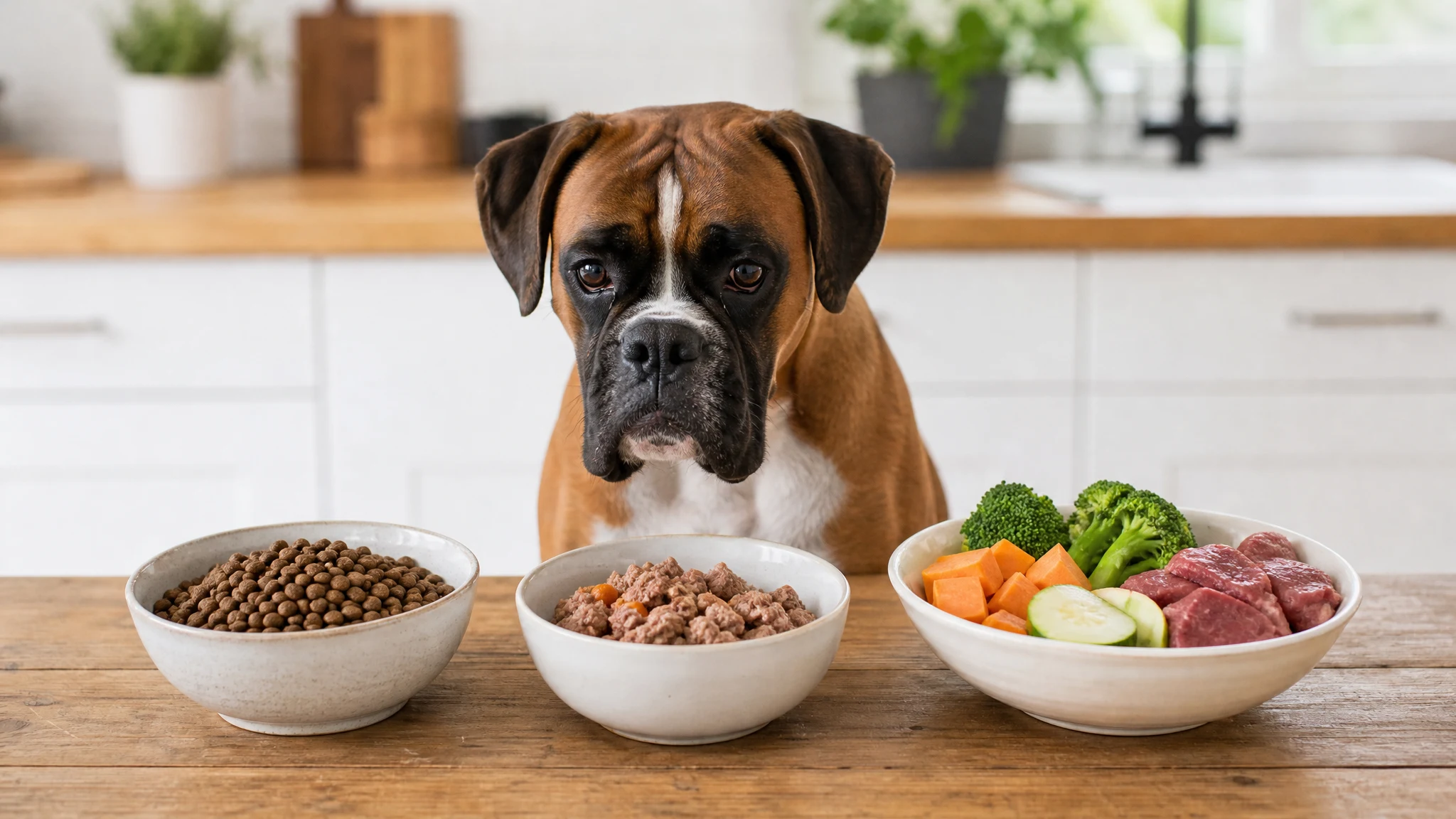
Wet vs Dry vs Fresh Food for Boxers
General nutrition information compiled from product labels and published sources, not veterinary advice. Your veterinarian is the right person to choose a diet for your dog, especially one with a health condition.
Most owners start with one question: is wet vs dry dog food the bigger decision, or does fresh dog food for Boxers change the picture? The honest answer is that the form matters less than whether the food is complete and balanced for your dog's life stage, and whether you can feed it consistently.
This page compares the three forms using label data from products on the market. We did not run feeding trials or taste tests, and we did not feed any of these foods ourselves. Label data tells you what a company says is in the bag, can or pack. It cannot tell you how a particular dog will do.
Start with the Boxer, not the format
PetMD describes the Boxer as a medium dog, about 65 to 80 pounds, with a life expectancy of 10 to 12 years. That weight range matters for portions, and it sits right at the edge of a labeling line for puppies that we cover below.
PetMD also says Boxers need quality protein for healthy muscles, including the heart, and lists excess weight and joint strain among the concerns for the breed. For bloat (GDV), PetMD advises two meals a day about 12 hours apart, no raised food bowls, and slow feeder bowls. None of the sources we read ties wet, dry or fresh food to bloat risk, so treat those feeding habits as the guidance, whatever form you choose.
On heart disease, the FDA says it has not found a definitive diet link to non-hereditary dilated cardiomyopathy (DCM) in dogs and has not asked for any recalls. The agency also says it does not know the specific connection between certain diets and cases of non-hereditary DCM. PetMD gives no diet cure for ARVC, the heart condition seen in Boxers. No food form prevents or treats a heart condition, and your veterinarian is the person to ask about your individual dog.
Comparison table
| Attribute | Dry | Wet (canned) | Fresh |
|---|---|---|---|
| Label examples compared | Royal Canin Boxer Adult, Hill's Science Diet Adult Large Breed, VICTOR Elite Canine | Hill's Science Diet Adult Chicken & Barley Entree, VICTOR Chicken and Rice Formula Pate | Freshpet Home Cooked Chicken, Nom Nom Chicken Cuisine, JustFoodForDogs Pantry Fresh Chicken & Rice |
| Calories as listed | 335 to 386 kcal per cup | 369 kcal per 13 oz can (Hill's); 448 kcal per 13.2 oz can (VICTOR) | 189 kcal per cup (Freshpet); 244 kcal per cup (Nom Nom); 387.5 kcal per 12.5 oz pack (JustFoodForDogs) |
| Water in the recipe | Low. Not the first ingredient on any dry label we compared. | High. Water is the first ingredient on the Hill's canned label. | Not stated as a percentage on the pages we compared. Labels list chicken first. |
| Minimum protein as listed | 24 to 25 percent (Royal Canin, VICTOR Elite) | 9 percent (VICTOR pate) | 15 percent (Freshpet); 6.5 percent (Nom Nom, JustFoodForDogs) |
| Storage notes on the page | Not stated in the material we compared | Check the label | Freshpet: refrigerated, use within 7 days of opening. Nom Nom: frozen. JustFoodForDogs: shelf-stable until opened. |
| Cost per day | Generally the lowest per day | Generally higher than dry | Generally the highest |
| Puppy suitability | Varies by product; read the AAFCO statement | Varies; the two we compared are not for large-size growth or are adult only | Varies; read the full statement |
The protein row needs a warning. Minimums printed on a can, a pack and a bag are not directly comparable, because they include different amounts of water. A 9 percent protein pate and a 25 percent protein kibble are not necessarily far apart once the water is removed. Brands that publish a dry matter figure make this easier, so look for it, or ask the brand.
Dry food
Dry food is the default for good reasons. It is compact and easy to measure, and it usually costs less per day than the other two forms.
Pros
- Calorie-dense and easy to portion. The dry foods we compared list 335 to 386 kcal per cup.
- Includes the only breed-specific formula in this group. Royal Canin's Boxer Adult is aimed at purebred Boxers 15 months and older, with 24 percent minimum protein, 18 percent minimum fat and 4.5 percent maximum fiber.
- Includes options labeled for large-size growth. The VICTOR Elite Canine statement covers all life stages, including growth of large size dogs.
- Simple to use with a slow feeder bowl, which PetMD recommends for bloat-prone breeds.
Cons
- Low in water, so it is not a way to add fluids to the diet.
- Easy to overfeed by the scoop. Because dry food is dense, a small extra scoop adds a lot of calories, and excess weight strains joints according to PetMD.
- Kibble size is a gap. None of the dry product pages we compared gave kibble dimensions. Royal Canin describes a wave-shaped kibble without measurements.
Wet food
People asking about wet food for Boxers usually want taste appeal, a softer texture, or a way to encourage a picky eater. Canned food does those jobs well, with trade-offs in cost and bulk.
Pros
- High water content. Water is the first ingredient on the Hill's Science Diet canned label.
- Soft texture, which can help if a dog has trouble with hard kibble. Ask your veterinarian if you suspect a mouth problem.
- Easy to use as a topper or partial meal.
Cons
- More cans for a dog this size. Hill's canned feeding guide lists 3 1/4 cans a day for a 50 pound dog. Its large breed dry food guide lists 3 1/4 cups for the same dog, which works out to roughly 1,200 kcal either way by label math. For a Boxer in the 65 to 80 pound range, that means a lot of cans to open and store.
- Not all canned foods suit growing Boxers. The VICTOR pate is labeled for growth and maintenance except for growth of large size dogs (70 pounds or more as an adult). The Hill's canned food is labeled for adults.
- Calories per can vary widely, from 369 kcal for the Hill's can to 448 kcal for the VICTOR can. Cans of different brands are not interchangeable.
Fresh food
Fresh dog food for Boxers comes in refrigerated, frozen and shelf-stable forms. The three we compared all describe cooked recipes that list chicken or a similar protein first.
Pros
- Short, recognizable ingredient lists. Freshpet's first five are chicken, eggs, cranberries, carrots and ground oats.
- Lower calories per cup, which can make portions look more generous. Freshpet lists 189 kcal per cup and Nom Nom lists 244 kcal per cup.
- Some pages state large-size growth. Nom Nom's page describes the recipe as covering all life stages including growth of large-size dogs. Read the full statement on the brand's page before relying on that.
Cons
- Storage. Freshpet says to use it within 7 days of opening, and Nom Nom is sold frozen. Plan fridge and freezer space.
- Cost. Fresh food is generally the most expensive way to feed a 65 to 80 pound dog every day. We are not listing prices because they change and we did not find them on the product pages we used.
- Not all pages give per-cup numbers. JustFoodForDogs lists calories per pack, not per cup, and its page links to a feeding calculator instead of a text table.
- Not every fresh recipe is for puppies. The Freshpet recipe we compared is formulated for adult maintenance.
Calories: why cups mislead
A cup of Freshpet at 189 kcal and a cup of VICTOR Elite at 386 kcal are very different amounts of energy. If you switch forms and keep the same volume, you could under or overfeed by a wide margin.
Use each brand's feeding guide as a starting point and adjust to body condition. Hill's feeding guides say to adjust amounts to maintain optimal weight, which is good advice for any product. Ask your veterinarian how to judge your dog's weight.
Dental myths
A common belief is that dry food cleans teeth and wet food ruins them. None of the product pages we compared make a dental claim for the foods listed, and nothing in the breed sources we used addresses it. We would not rely on food form alone for dental care. Ask your veterinarian what dental care your Boxer needs.
Mixing forms
Many owners combine dry with a spoonful of wet or fresh. This is allowed as long as the total calories stay in line. Royal Canin's Boxer Adult page includes both dry and mixed feeding tables, which shows that brands expect owners to mix.
- Count the topper. Subtract calories from the dry portion so the daily total stays the same.
- Use complete and balanced foods. Check the AAFCO statement on each one.
- Change gradually. Brands suggest 7 days (Hill's puppy food), 7 to 10 days (VICTOR Senior Healthy Weight) or 10 days (Freshpet).
Puppies and the large-size label
A review by Tal and colleagues in the Canadian Veterinary Journal links excess energy and excess calcium during growth to developmental orthopedic disease in large-breed puppies. It found no Boxer-specific calcium guidance, and we did not either.
Whole Dog Journal explains that foods labeled for growth or all life stages must say whether they meet the profile "including" or "except for" growth of large-size dogs, meaning dogs of 70 pounds or more as adults. Male Boxers at 65 to 80 pounds sit right at that cutoff. A Boxer puppy can be fed a food whose label says "including growth of large-size dogs". This is not a requirement, and your veterinarian decides what suits an individual puppy.
Among the foods we compared, VICTOR Elite Canine says "including", while VICTOR Hi-Pro Plus and the VICTOR pate say "except for". The Hill's Puppy Large Breed statement we saw does not say whether it covers large-size growth, so read the product page itself. Whatever the form, read the statement on the label before you buy.
Best for: use cases
- Adult Boxer, everyday feeding: a complete and balanced dry food, such as Royal Canin's Boxer Adult formula or a large-breed adult recipe. It is the easiest to portion and the easiest on the budget.
- Picky eater or soft-texture need: a canned topper on top of a measured dry portion, with the calories counted. Ask your veterinarian first if the dog is refusing food.
- Owners who want a fresh option and have fridge space: a fresh recipe, with the cost and the storage rules in mind.
- Growing puppy: any form, as long as the label says "including growth of large-size dogs" or your veterinarian approves another choice.
- Weight control: whichever form you can measure accurately. Dry food allows the most precise measuring, while fresh and wet foods make it easy to lose track of calories.
Verdict
There is no single winner, but the label data points to a practical order. For most adult Boxers, a complete and balanced dry food is the sensible base: it has the widest range of labeled options, including the one breed-specific formula, and it is the simplest to portion by calories. Wet and fresh foods are good additions or alternatives when texture, appeal or preference matter and the household can handle the extra cost and storage.
The reasoning is about reliability, not magic. A food your Boxer eats consistently, at a calorie level that keeps the dog lean, beats a more impressive food that gets measured loosely. Whatever form you choose, check the AAFCO statement, match it to your dog's life stage, and ask your veterinarian before making large changes. Brands do not publish kibble dimensions on the pages we compared, so if size or shape is a concern, ask the brand directly.
For a side by side of individual products, see our Boxer dog foods compared by label data.
Sources
- PetMD Boxer breed page
- FDA CVM, Questions and Answers: FDA's Work on Potential Causes of Non-Hereditary DCM in Dogs
- Tal et al., Can Vet J 2018;59(1):36-42
- Whole Dog Journal, In the Fine Print: Nutritional Adequacy Statements
- Royal Canin Boxer Adult
- Hill's Science Diet Adult Large Breed
- Hill's Science Diet Puppy Large Breed
- Hill's Science Diet Adult Chicken & Barley Entree (canned)
- VICTOR Elite Canine
- VICTOR Hi-Pro Plus
- VICTOR Senior Healthy Weight
- VICTOR Chicken and Rice Formula Pate
- Freshpet Fresh From the Kitchen Home Cooked Chicken Recipe
- Nom Nom Chicken Cuisine
- JustFoodForDogs Pantry Fresh Chicken & Rice