Best Dog Food for Boxers: Foods Compared by Label Data
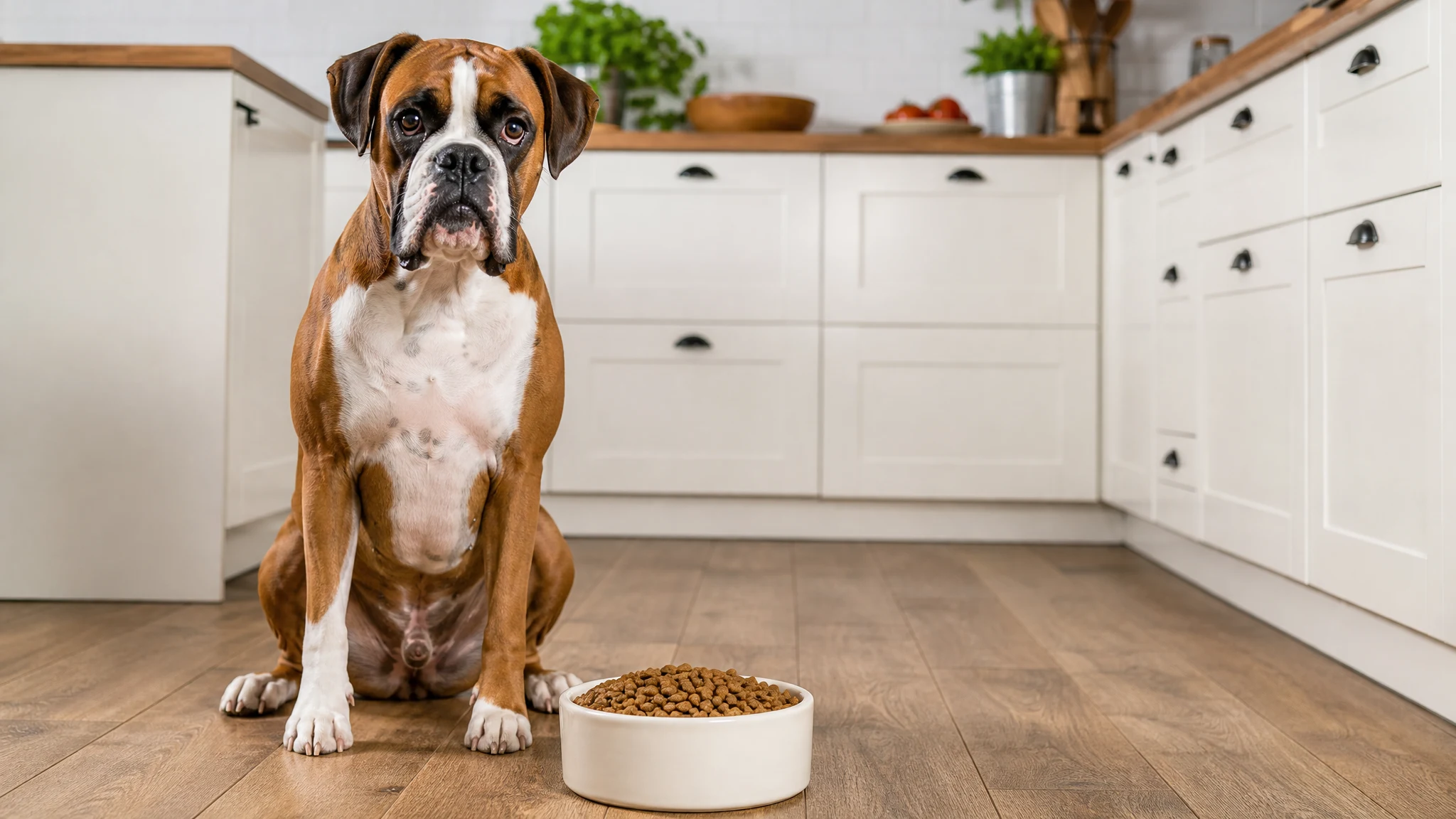
General nutrition information compiled from product labels and published sources, not veterinary advice. Your veterinarian is the right person to choose a diet for your dog, especially one with a health condition.
Anyone shopping for the best dog food for Boxers meets loud claims fast. Bags promise strength, shine, heart health and more. This guide ignores most of that and reads the label instead.
You will find how we compared foods, what the Boxer breed sources say about diet, and eleven foods sorted by situation: adult, puppy, senior, weight control, sensitive stomach, wet and fresh. Each pick shows what the brand's own page says and who it may suit. None of it replaces your veterinarian, who decides what an individual dog should eat.
How we compared these foods
We compared label data. For each food we looked at what the brand publishes on its own product page: the AAFCO nutritional adequacy statement, the life stage, the guaranteed analysis, calories per cup, the first five ingredients and the kibble size when it is given.
We did not run feeding trials. We did not do taste tests. We did not feed these foods to dogs and report back. A label can tell you what a food is formulated to do and what is in it. It cannot tell you how your dog will do on it.
Three limits are worth knowing up front:
- Not every number is comparable. Some brands publish a guaranteed minimum. Hill's Science Diet pages give only a dry matter average, which is a different kind of number. Wet and fresh foods hold water, so their protein and fat percentages look low next to dry food. Compare within a form, not across forms.
- Kibble size is mostly unknown. Royal Canin describes a wave-shaped kibble for its Boxer food but gives no dimensions. The other dry foods here do not state a size on the pages we reviewed. If kibble size matters for your dog, check with the brand.
- We have no price data. We will not guess at prices. A later section shows how to work out cost per day yourself.
What the Boxer breed sources say about diet
A food guide for one breed should start with that breed. These points come from breed and health organizations, and none of them is a diet cure.
Size and lifespan
PetMD's Boxer breed page lists an adult weight of about 65 to 80 pounds, a height of 21 to 25 inches, a medium size category and a life expectancy of 10 to 12 years. The Westminster Kennel Club breed page is a good starting point for the breed standard and general background.
Protein and muscle
PetMD says Boxers need quality protein for healthy muscles, including the heart. It also names ARVC, often called Boxer cardiomyopathy, as a breed concern. PetMD gives no diet cure for ARVC, and no food can be said to prevent it. If your dog has a heart diagnosis, your veterinarian or a veterinary cardiologist should guide the diet.
Meal pattern and bloat
For bloat, also called GDV, PetMD advises two meals a day about 12 hours apart, no raised food bowls, and slow feeder bowls. These are feeding habits, not product features. They cost nothing to follow whatever food you choose.
Weight and joints
PetMD lists excess weight and joint strain as a concern. The American Boxer Club health page covers hip dysplasia and chronic kidney disease. On hip dysplasia it says other factors such as diet and conditioning cannot be ruled out, and it gives no specific diet advice. On kidney disease it gives no diet advice. We found no further breed guidance on those two topics, so ask your veterinarian.
When a puppy becomes an adult
PetMD gives no switch age for Boxers and says to ask the vet. The UK Kennel Club says dogs over 26 kg (about 57 lb) reach adulthood between 15 months and 2 years. That is a general rule for larger dogs, not a Boxer rule. Royal Canin's Boxer Adult formula is labeled for purebred Boxers 15 months and older, which fits inside that range.
What to look for on a label
1. The AAFCO statement
This is the single most useful line on the bag. It says whether the food is formulated to meet an AAFCO nutrient profile, and for which life stage. A food meant as the main diet should say it is complete and balanced for maintenance, growth, or all life stages. Some statements say the food was proven through feeding tests using AAFCO procedures. Others say it was formulated to meet the profile. Both are legitimate routes, and they are different claims.
2. The large-size growth wording
Foods labeled for growth or all life stages must say whether they meet the profile "including" or "except for" growth of large-size dogs, defined as 70 pounds or more as an adult. Whole Dog Journal explains this in its guide to nutritional adequacy statements. "Including" means formulated for large-breed puppies. "Except for" means it is not.
This matters for Boxers because males run 65 to 80 pounds, right at the 70 pound line. A Boxer puppy can be fed a food whose label says "including growth of large-size dogs." That is a reasonable choice, not a requirement. A review in the Canadian Veterinary Journal (Tal et al., 2018) links excess energy and excess calcium during growth to developmental orthopedic disease in large-breed puppies. We found no Boxer-specific calcium guidance, so ask your veterinarian or the brand about calcium for your puppy.
3. Calories per cup
Two foods with similar protein can differ a lot in calories. The same cup measure delivers more energy from a calorie-dense food. If you swap foods, recheck the portion. Our feeding amounts are only label starting points, and the Boxer feeding chart by age and weight covers how to adjust them.
4. The first five ingredients
Ingredients are listed by weight before cooking. The first five show the bulk of the recipe, but they are not the whole story. Look for named ingredients, such as chicken or chicken meal, rather than vague terms. Do not treat one ingredient as a verdict.
5. Guaranteed analysis
This gives minimum protein and fat and maximum fiber and moisture. Compare these only between foods that report them the same way.
The comparison at a glance
All figures come from each brand's own product page. "Per can" and "per pack" figures are not per cup and should not be compared with cup figures. Hill's percentages are dry matter averages, not guaranteed minimums.
| Food | Form | Life stage on label | Protein / fat / fiber | Calories |
|---|---|---|---|---|
| Royal Canin Boxer Adult | Dry | Adult, Boxers 15 months and older | 24% min / 18% min / 4.5% max | 335 kcal per cup |
| Hill's Science Diet Adult Large Breed Chicken & Barley | Dry | Adult, 1 to 5 years, large breeds | 23.8% / 15% / 1.7% (dry matter avg) | 365 kcal per cup |
| Hill's Science Diet Puppy Large Breed Chicken & Brown Rice | Dry | Large breed puppy, up to 18 months | 26.7% / 15.4% / 2.8% (dry matter avg) | 387 kcal per cup |
| Hill's Science Diet Adult 6+ Large Breed Chicken Meal, Barley & Rice | Dry | Mature adult, 6+ years, large breeds | 18.7% / 13.5% / 2.4% (dry matter avg) | 352 kcal per cup |
| VICTOR Elite Canine | Dry | All life stages, including large-size growth | 25% min / 14% min / 4% max | 386 kcal per cup |
| VICTOR Hi-Pro Plus | Dry | All life stages, except large-size growth | 30% min / 20% min / 3.8% max | 406 kcal per cup |
| VICTOR Senior Healthy Weight | Dry | Adult maintenance | 27% min / 11.5% min / 4.5% max | 360 kcal per cup |
| Hill's Science Diet Adult Chicken & Barley Entree | Canned | Adult, 1 to 6 years | 26.7% / 16.7% / 1% (dry matter avg) | 369 kcal per 13 oz can |
| VICTOR Chicken and Rice Formula Pate | Canned | Growth and maintenance, except large-size growth | 9% min / 6% min / 1% max | 448 kcal per can |
| Freshpet Fresh From the Kitchen Home Cooked Chicken | Fresh, refrigerated | Adult maintenance | 15% / 11% / 1% | 189 kcal per cup |
| Nom Nom Chicken Cuisine | Fresh, frozen | All life stages incl. large-size growth, per brand page | 6.5% / 4.5% / 3.5% (as fed) | 244 kcal per cup |
| JustFoodForDogs Pantry Fresh Chicken & Rice | Fresh, shelf-stable | All life stages | 6.5% / 2.5% / 1% | 387.5 kcal per 12.5 oz pack |
Picks by situation
These are not rankings. Each food is described by its label, and the "who it may suit" notes are reading aids, not recommendations for your individual dog.
Adult Boxers: breed formula or large-breed formula
Royal Canin Boxer Adult is the one food here built around the breed. The page says it is formulated to meet AAFCO maintenance levels. The first five ingredients are brown rice, brewers rice, chicken fat, chicken by-product meal and oat groats. The guaranteed analysis shows 24% protein minimum, 18% fat minimum and 4.5% fiber maximum, at 335 kcal per cup. The page offers dry and mixed feeding tables by weight and activity level.
It may suit owners who want a formula aimed at purebred adult Boxers and are comfortable with by-product meal in the list. It is the lowest in calories per cup among the dry foods here, which makes cup measuring easier to keep honest. A breed name on the bag is still marketing until you read the statement underneath it.
Hill's Science Diet Adult Large Breed Chicken & Barley is labeled for large breeds of 55 to 110 pounds, ages 1 to 5. Its statement says animal feeding tests using AAFCO procedures support complete and balanced nutrition for adult maintenance. The first five ingredients are chicken, cracked pearled barley, brown rice, brewers rice and whole grain wheat, at 365 kcal per cup. The page gives dry matter averages of 23.8% protein and 15% fat, not guaranteed minimums. Hill's says it is not for large-breed puppies.
It may suit owners who prefer a food backed by an AAFCO feeding-test statement and a plain grain-inclusive recipe. The Hill's page gives an example of 3 1/4 cups a day for a 50 pound dog and 5 1/3 cups for 100 pounds, and says to adjust to maintain optimal weight.
Puppies
VICTOR Elite Canine has the clearest statement for a Boxer puppy. The page says it is formulated to meet AAFCO profiles for all life stages, including growth of large size dogs (70 lb or more as an adult). The first five ingredients are chicken meal, whole grain brown rice, grain sorghum, peas and chicken fat. It lists 25% protein minimum, 14% fat minimum and 4% fiber maximum, at 386 kcal per cup. The brand says puppies are fed as much as they eat in 20 minutes, in four feedings a day. Treat that as a starting point and ask your veterinarian about portions for your puppy.
Hill's Science Diet Puppy Large Breed Chicken & Brown Rice is aimed at large-breed puppies up to 18 months. The statement says animal feeding tests using AAFCO procedures support complete and balanced nutrition for growing puppies. We could not confirm from the page whether that statement names large-size growth, so check the Hill's page before relying on that point. Its first five ingredients are chicken, brown rice, whole grain oats, chicken meal and cracked pearled barley, at 387 kcal per cup. The feeding chart runs by weight and age band, and Hill's suggests a 7 day transition.
Royal Canin: we did not find a Royal Canin Boxer puppy formula in the sources we reviewed. If you want one, check with the brand.
One caution from the research: excess energy during growth is linked to rapid growth and developmental orthopedic disease. A calorie-dense puppy food is not a problem by itself, but portions matter more than the brand. Rapid growth is not a goal.
You can read more about switching foods in the feeding chart. Training treats count toward daily calories too, as the page on training treats for Boxers explains.
Senior Boxers
Hill's Science Diet Adult 6+ Large Breed Chicken Meal, Barley & Rice is labeled for mature large-breed adults of 6 years and older (55 to 110 pounds). It carries an AAFCO feeding-test statement for adult maintenance. The first five ingredients are chicken meal, cracked pearled barley, brewers rice, whole grain wheat and whole grain corn. The dry matter averages are 18.7% protein and 13.5% fat, at 352 kcal per cup. The page gives 3 cups a day for a 50 pound dog and 4 3/4 cups for 100 pounds.
It has the lowest protein figure in this comparison, so check it with your veterinarian if your senior Boxer's muscle condition is a concern. Our page on the best food for senior Boxers goes deeper on this life stage.
Weight control
VICTOR Senior Healthy Weight is formulated for AAFCO adult maintenance, so its "senior" name is not a legal age cutoff. The first five ingredients are beef meal, whole grain brown rice, whole grain millet, grain sorghum and chicken fat. It lists 27% protein minimum, 11.5% fat minimum and 4.5% fiber maximum, at 360 kcal per cup. That is the lowest fat figure of any dry food here. The page also says it is fortified with glucosamine and chondroitin, and gives a daily amount table plus a weight reduction table, with a 7 to 10 day transition.
It may suit an adult Boxer whose veterinarian has said to trim calories. Use the weight reduction table only as a starting point and let your vet set the target. No food on its own fixes excess weight. Measured portions, limited extras and exercise do more than the bag does.
Sensitive stomach
None of the foods we compared is labeled by its brand for sensitive stomachs, and we will not label one that way. Digestive trouble can come from many causes, and a veterinarian should look at it, especially if it is frequent or severe. Prescription diets are something only a veterinarian prescribes.
If your vet suggests changing foods, a gradual transition is the usual advice. Hill's and VICTOR both give transition guidance on their pages, over 7 days and 7 to 10 days respectively. Keep table scraps out too, and check human foods Boxers should never eat.
Wet food
Hill's Science Diet Adult Chicken & Barley Entree comes in 13 oz cans for adults aged 1 to 6 years of any size. The statement is an AAFCO feeding-test one for adult maintenance. The first five ingredients are water, chicken, pork liver, whole grain corn and cracked pearled barley. It has 369 kcal per can. The page's example amounts are 1 can a day for a 10 pound dog, 3 1/4 cans for 50 pounds and 6 cans for 120 pounds. At Boxer weights that is a lot of cans a day, which is worth knowing before you plan to feed it alone.
VICTOR Chicken and Rice Formula Pate is a 13.2 oz can formulated for growth and maintenance, except for growth of large size dogs. That makes it a poor fit as a puppy food for a Boxer expected to be near 70 pounds. The first five ingredients are chicken, chicken broth, chicken liver, brown rice and dried egg product. It lists 9% protein minimum, 6% fat minimum and 1% fiber maximum, at 448 kcal per can. Adults get 3/4 to 1 can per 15 pounds of body weight.
Both cans may suit owners who want to mix wet food into kibble or add variety. If you mix, reduce the kibble so the day's total calories stay the same.
Fresh food
Freshpet Fresh From the Kitchen Home Cooked Chicken Recipe is refrigerated and formulated for adult maintenance. The first five ingredients are chicken, eggs, cranberries, carrots and ground oats. It lists 15% protein, 11% fat and 1% fiber, at 189 kcal per cup (calculated). The page says to use it within 7 days of opening and gives a 10 day transition. The feeding guide runs from 3/4 to 1 1/2 cups for 4 to 10 pound dogs up to 5 1/4 cups over 65 pounds, plus 1 cup for each extra 20 pounds. At 189 kcal per cup, an adult Boxer eats a large volume.
Nom Nom Chicken Cuisine is gently cooked and frozen. The page says it covers all life stages, including growth of large-size dogs. The part of the AAFCO statement we could confirm says it is formulated to meet the AAFCO Dog Food Nutrient Profiles, so read the full statement on Nom Nom's page. The first five ingredients are chicken, sweet potatoes, squash, spinach and dicalcium phosphate. As fed, it lists 6.5% protein, 4.5% fat and 3.5% fiber, at 244 kcal per cup. Whether it is grain free is not stated on the page we reviewed, so check with the brand.
JustFoodForDogs Pantry Fresh Chicken & Rice is a shelf-stable cooked food in 12.5 oz packs, formulated for all life stages. Its first five ingredients are chicken breast, chicken thighs, chicken liver, long-grain white rice and kale. It lists 6.5% protein, 2.5% fat and 1% fiber, at 387.5 kcal per pack (31 kcal per ounce). Amounts come from a feeding calculator on the brand's page. The page may also cover large-size growth, but the statement was not clear to us, so read it in full there before feeding it to a puppy.
Fresh foods may suit owners who value whole-food ingredient lists and do not mind storage rules. Calories per cup are low compared with kibble, which affects portion size and cost. Because the percentages are as fed, do not set them against the dry foods above.
Price points
We have no verified prices for any of these foods, and prices change by store and region. Rather than rank by cost we can show you how to compare it yourself:
- Take the brand's feeding guide amount for your dog's weight, in cups per day.
- Find how many cups are in the bag or how many cans or packs you need per day.
- Divide the price you actually pay by the number of days it lasts.
That cost per day is a fairer comparison than the price per bag. A pricier, calorie-dense food may need fewer cups a day. A cheaper, lower-calorie food may need more. Fresh and canned foods usually mean more containers per day for a dog of Boxer size, so run the numbers before you commit.
Red flags to avoid
- No AAFCO statement, or a vague one. If the bag does not say what life stage it covers, you cannot tell what it is for.
- A large-size growth mismatch for puppies. A food with "except for growth of large-size dogs" on the label is a poor match for a Boxer puppy. Hi-Pro Plus, for example, carries that wording. Its brand page notes that Boxers are usually under 70 pounds, but PetMD lists males up to 80, so it is borderline. Ask your veterinarian before using it for a puppy.
- Disease claims. Any food that says it prevents, treats or cures hip dysplasia, allergies, heart disease or bloat is making a claim that a food label should not make. Treat it as a reason to be careful.
- Fear-based marketing. Words like "toxin-free" or "what vets don't tell you" are sales language, not nutrition data.
- Changing foods overnight. Sudden switches are a common cause of upset stomachs. Use the brand's stated transition period.
- Ignoring calories. Guessing a scoop is the quickest route to extra weight. Use a measuring cup or a kitchen scale.
Grain-free and the FDA heart disease investigation
Many owners ask about grain-free foods and dilated cardiomyopathy (DCM). The FDA's Center for Veterinary Medicine says on its question and answer page (content current as of August 19, 2024) that it has not found a definitive diet link to non-hereditary DCM and has not asked for any recalls. It counted 1,382 DCM reports from January 1, 2014 to November 1, 2022. It adds: "The FDA does not know the specific connection between these diets and cases of non-hereditary DCM."
The FDA's main investigation page says it does not intend to release further public updates until there is meaningful new scientific information to share. None of the foods in this guide is marked grain free by its brand, apart from Nom Nom, where the page does not say. For a longer look at the question, read grain-free food and Boxers: what the FDA DCM investigation says. Your veterinarian can advise on any diet choice for a Boxer with heart concerns.
Where to buy
We do not link to stores, and we do not recommend one. Each brand's own product page, linked above, is the place to confirm the current recipe, the full AAFCO statement and the feeding guide. Brands update formulas, so read the label on the bag you are holding and not only what you saw online.
When you buy, check three things on the package itself: the life stage, the large-size growth wording and the best-by date. For fresh and refrigerated foods, follow the brand's storage and use-within rules. If a brand's page does not say how it sells the food where you live, ask the brand.
A simple way to choose
- Pick the life stage first. Puppy, adult or senior drives everything else.
- For a puppy, look for "including growth of large-size dogs" and ask your veterinarian about portions.
- Compare calories per cup, not just protein.
- Feed two meals about 12 hours apart, with the bowl at floor level, as PetMD advises.
- Measure portions, then check your dog's body condition every few weeks.
- Change foods slowly, and ask your veterinarian about any health concern.
The best food for Boxers is the one that matches the dog's life stage, keeps a healthy body weight and is one you can feed consistently. A label can narrow the field. Your veterinarian helps with the rest.
More Boxer feeding guides
- Best food for senior Boxers
- How much to feed a Boxer: feeding chart by age and weight
- Grain-free food and Boxers: what the FDA DCM investigation says
- Best training treats for Boxers and how many to give
- Human foods Boxers should never eat
Sources
- Westminster Kennel Club, Boxer breed page
- PetMD, Boxer breed page
- American Boxer Club, health page
- The Kennel Club (UK), Puppy food to adult food
- Tal et al., Canadian Veterinary Journal 2018;59(1):36-42
- Whole Dog Journal, In the Fine Print: Nutritional Adequacy Statements
- FDA CVM, Questions and Answers: FDA's Work on Potential Causes of Non-Hereditary DCM in Dogs
- FDA, Investigation into a Potential Link Between Certain Diets and Canine DCM
- Royal Canin, Boxer Adult product page
- Hill's Pet Nutrition, product pages for the Science Diet foods named above
- VICTOR Pet Food, product pages for the VICTOR foods named above
- Freshpet, product page
- Nom Nom, product page
- JustFoodForDogs, product page