Raw Diets for Boxers: Label Claims, Risks and Vet Guidance
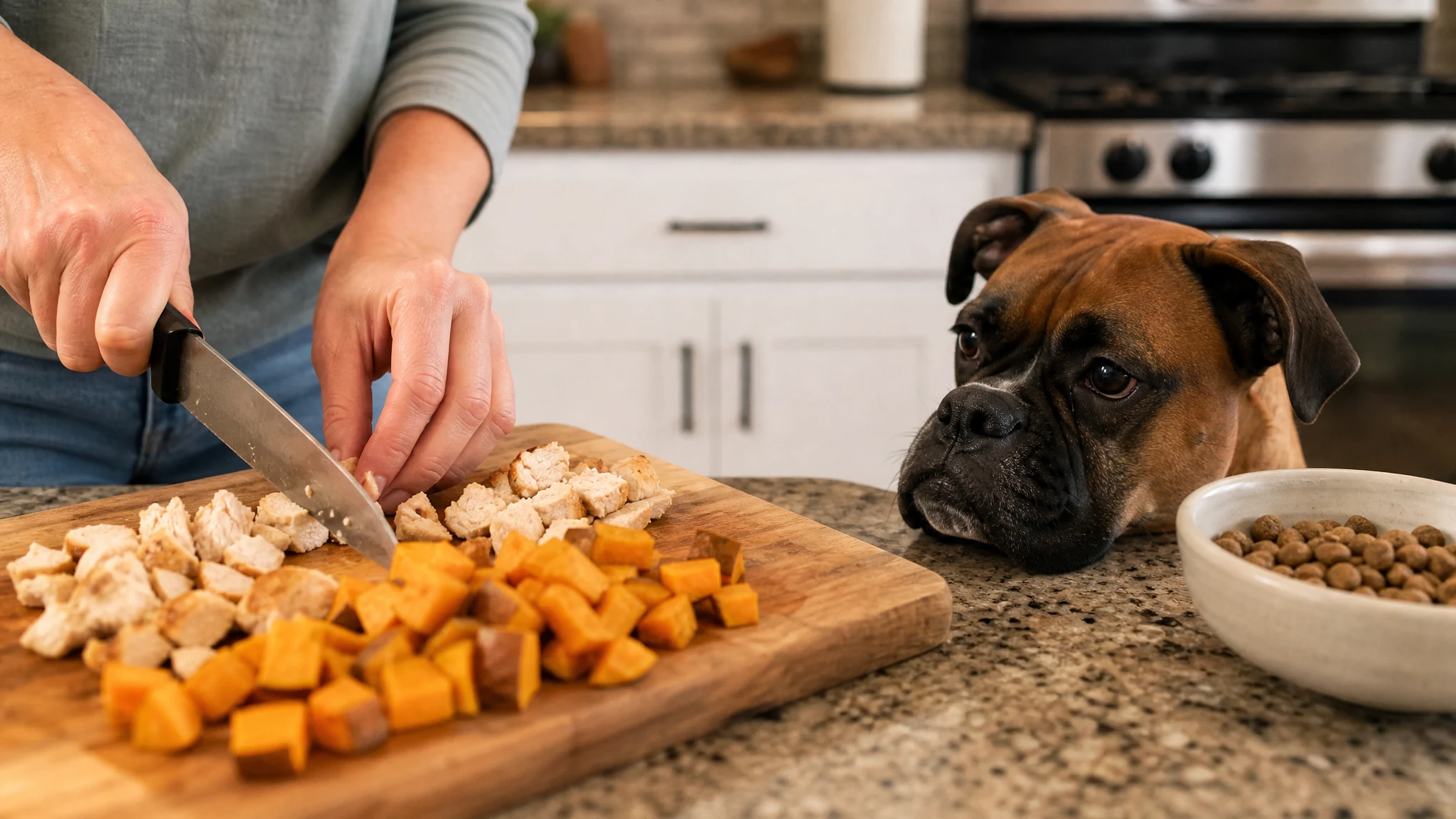
General nutrition information compiled from product labels and published sources, not veterinary advice. Your veterinarian is the right person to choose a diet for your dog, especially one with a health condition.
Many Boxer owners ask about raw feeding, and some go looking for the best raw dog food for Boxers. This guide doesn't crown a winner. It shows you how to read a raw food label, what questions to ask, and how to plan a change with your veterinarian.
We compared label data from public product pages. We did not run feeding trials or taste tests, and we did not feed any food to a dog. None of the products in our comparison data are raw, so we name no raw brand here. For any raw product you are considering, check the brand's own page and ask the company directly.
What you need before you start
- Your Boxer's current weight and body condition, ideally from a recent vet visit.
- The label or product page of each food you are considering, including the full ingredient list and the nutritional adequacy statement.
- A list of questions for your veterinarian (see step 6).
- A kitchen scale and a notebook to track meals, stools and weight.
- A slow feeder bowl, if your vet agrees. PetMD advises slow feeder bowls for Boxers.
Step 1: Know the Boxer basics
PetMD lists adult Boxers at about 65 to 80 pounds, a medium-size breed, with a life expectancy of 10 to 12 years. That weight range matters for labels, as step 3 explains.
PetMD also says Boxers need quality protein for healthy muscles, including the heart. For a deeper look at the breed's diet factors, see our guide to Boxer nutrition and the diet factors that matter for this breed.
Step 2: Be clear about what a raw diet claims
Raw diets are often sold with promises about shinier coats, better digestion or a more natural way of eating. Treat these as marketing until you see a source. We found no Boxer-specific research in our sources showing that a raw diet improves any health outcome in the breed.
Be especially wary of any claim that a food prevents, treats or cures a condition. No food page we reviewed makes that claim for Boxers, and a brand that does should be questioned. Your veterinarian decides what suits an individual dog.
What the heart-health discussion does and does not say
Boxers can develop ARVC, a heart condition sometimes called Boxer cardiomyopathy. PetMD gives no diet cure for it. Separately, the FDA has looked at non-hereditary dilated cardiomyopathy (DCM) in dogs. In its Q&A, the FDA says it has not found a definitive diet link and has not asked for any recalls. It also says it does not know the specific connection between certain diets and cases of non-hereditary DCM.
The FDA counted 1,382 DCM reports from January 1, 2014 to November 1, 2022. Its investigation page says it will not release further public updates until there is meaningful new scientific information. In short, the science is unsettled, so be cautious about any brand that claims to settle it.
Step 3: Read the nutritional adequacy statement
This is the most useful line on any label. A complete and balanced food carries a statement that it meets the AAFCO Dog Food Nutrient Profiles for a life stage. Look for three things:
- The life stage. Maintenance, growth, or all life stages.
- The method. Some foods are "formulated to meet" the profiles. Others are backed by animal feeding tests. Both appear in the product data we reviewed.
- The large-size wording. Per Whole Dog Journal's explanation of AAFCO rules, foods for growth or all life stages must say whether they meet the profile "including" or "except for" growth of large-size dogs (70 pounds or more as an adult).
Male Boxers can reach 65 to 80 pounds, so they sit near that 70-pound line. A Tal et al. literature review (Canadian Veterinary Journal, 2018) links excess energy and excess calcium during growth to developmental orthopedic disease in large-breed puppies. We found no Boxer-specific calcium guidance. A Boxer puppy can be fed a food whose label says "including growth of large-size dogs," but we are not saying that is required. Ask your vet.
For example, the VICTOR Elite Canine label says "including growth of large size dogs." The VICTOR Hi-Pro Plus label says "except for." That one word changes who the food is for. VICTOR's own pages are the place to confirm it. Both are kibble, not raw, and are shown only to illustrate the wording.
If a raw product has no adequacy statement, or calls itself "for supplemental feeding only," it is not a complete diet on its own. Ask the brand what that means for daily feeding.
Step 4: Compare label data, not slogans
Put each food's facts side by side. The table shows how the data can look for foods in our comparison. Raw products would need the same fields from the brand.
| Food (form) | Adequacy statement | Energy per label |
|---|---|---|
| Royal Canin Boxer Adult (dry) | Maintenance | 335 kcal per cup |
| Freshpet Home Cooked Chicken (fresh, cooked) | Adult maintenance | 189 kcal per cup |
| VICTOR Elite Canine (dry) | All life stages, including large-size growth | 386 kcal per cup |
Energy per cup varies a lot between forms, so a "cup" of one food is not a cup of another. That is why switching by volume can over- or underfeed. Ask any raw brand for calories per ounce or per pound, and for its full guaranteed analysis and ingredient list.
Step 5: Weigh the risks honestly
Our sources do not cover raw-feeding safety, so we won't quote figures. Raw meat needs careful kitchen handling, and a diet that is not complete and balanced can leave gaps over time. Ask your veterinarian how these apply to your household, especially if there are young children, older adults or anyone with a weakened immune system at home.
Consider cooked fresh foods as a middle path to discuss. Freshpet, Nom Nom and JustFoodForDogs each publish label data on their own pages. Nom Nom and JustFoodForDogs describe their foods as cooked, not raw. Check each brand's page for the full adequacy statement before comparing.
Step 6: Take your questions to the vet
Bring these to your appointment:
- Is my Boxer's weight and body condition suited to a diet change right now?
- Given the breed's heart and joint concerns, are there reasons to avoid or favor a particular diet?
- If we try a raw or fresh food, how do we confirm it is complete and balanced?
- How should I handle and store it safely at home?
- How often should we recheck weight and bloodwork?
The American Boxer Club health page says other factors such as diet and conditioning cannot be ruled out in hip dysplasia. It gives no specific diet advice, so do not assume a food will change that risk.
Step 7: Transition slowly and watch your dog
Brand pages we reviewed describe gradual transitions. Hill's suggests 7 days for its puppy food, VICTOR suggests 7 to 10 days for one senior food, and Freshpet describes 10 days. Use the new brand's own instructions as a starting point and adjust with your vet.
- Start with a small share of the new food mixed into the old one.
- Increase it gradually while watching appetite, stool and energy.
- Pause and call your vet if you see vomiting, ongoing diarrhea or lethargy.
Feeding guides on labels are starting points, not prescriptions. Adjust them to your dog's body condition, as the Hill's pages say. PetMD advises two meals a day about 12 hours apart and no raised food bowls, to reduce bloat risk. Always ask your vet what fits your dog.
Tips
- Weigh your Boxer every two to four weeks during a change. PetMD notes excess weight strains joints.
- Keep a log of the exact food, amount and any symptoms.
- Ask brands for the complete adequacy statement. Some fragments online omit the large-size wording.
- Do not feed hard exercise right after meals. Ask your vet about timing for bloat risk.
Common mistakes to avoid
- Home-mixing without a plan. Meat alone is not complete. Use a recipe approved by your veterinarian or a complete food.
- Trusting "natural" or "ancestral" wording. These are not nutritional standards.
- Judging by protein alone. Boxers need quality protein, but the whole profile matters.
- Switching a puppy to an adult or raw food on a guess. The Kennel Club (UK) says dogs over about 57 pounds reach adulthood between 15 months and 2 years. This is a general rule, not Boxer-specific, and PetMD gives no switch age for Boxers. Ask your vet.
- Assuming a recall-free brand is safe. We have no recall data, so check with the brand and the FDA.
What results to expect
Some owners report glossier coats or smaller stools after a diet change. Our sources do not show that a raw diet produces these results in Boxers, and results vary by dog. A well-chosen complete and balanced diet may help you keep a healthy weight and steady energy, but no food is guaranteed to change health outcomes. Your vet's checkups are the real measure.
So the best raw dog food for Boxers, if you choose that route, is one that is clearly labeled complete and balanced for your dog's life stage, backed by transparent label data and approved by your veterinarian.
Sources
- PetMD Boxer breed page
- American Boxer Club health page
- FDA CVM, Questions and Answers: FDA's Work on Potential Causes of Non-Hereditary DCM in Dogs
- FDA investigation page on diets and canine DCM
- Tal et al., Canadian Veterinary Journal 2018
- Whole Dog Journal, In the Fine Print: Nutritional Adequacy Statements
- The Kennel Club (UK), Puppy food to adult food
- Royal Canin Boxer Adult product page
- VICTOR Elite Canine product page
- VICTOR Hi-Pro Plus product page
- Freshpet Home Cooked Chicken Recipe product page
- Nom Nom Chicken Cuisine product page
- JustFoodForDogs Pantry Fresh Chicken & Rice product page