Rice for Boxers: When It Helps and When to Skip It
General nutrition information compiled from product labels and published sources, not veterinary advice. Your veterinarian is the right person to choose a diet for your dog, especially one with a health condition.
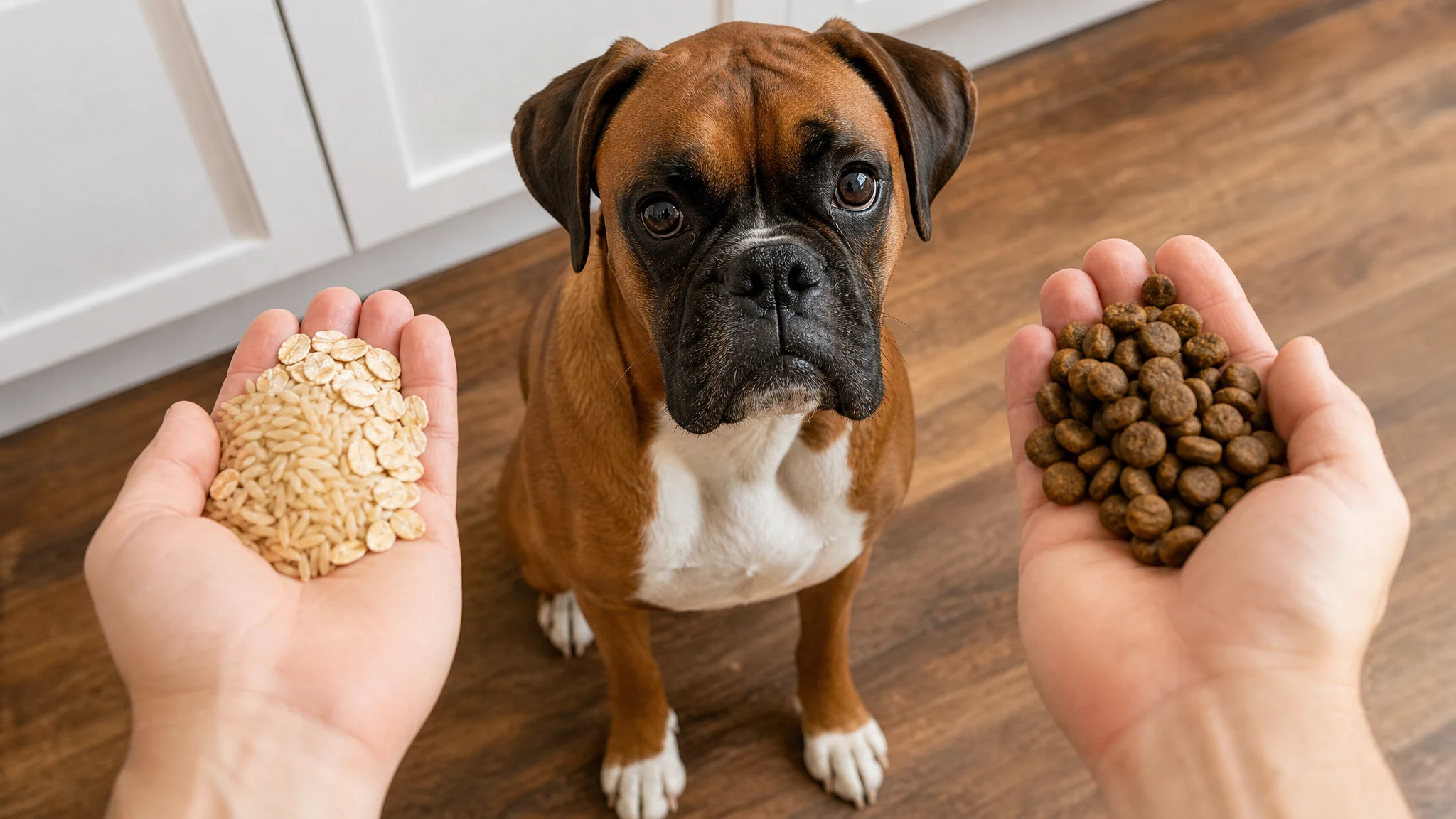
Rice is one of the most common ingredients in dog food, so owners often ask: can boxer dogs eat rice? In most cases rice is simply part of a complete food. Whether to add extra rice at home is a different question, and it depends on your dog.
This guide shows how to decide, step by step. It is based on label data and breed sources, not on feeding trials. We compared published label information. We did not run taste tests or feeding trials.
Quick answer
Rice shows up in many foods made for dogs of Boxer size, and none of the sources we relied on describe it as a problem for the breed. None of them say rice is needed, either. No food, rice included, has been shown to prevent or treat a Boxer health condition in the sources used here. A veterinarian decides what suits an individual dog.
For background on the wider picture, see our guide to Boxer nutrition and the diet factors that matter for this breed.
What you need
- The bag or can of your dog's current food, with the ingredient list and the nutritional adequacy statement
- The feeding guide from the brand's own page
- Your dog's current weight and body condition
- A measuring cup or kitchen scale
- A slow feeder bowl, if your dog eats fast
- Your veterinarian's phone number, for the questions below
If you plan to cook rice, you only need plain rice and water. Skip butter, oil, salt, onion, garlic and seasoning.
Step 1: Know your dog's size and stage
PetMD lists adult Boxers at about 65 to 80 pounds, with a life expectancy of 10 to 12 years. That puts many males near the 70 pound line AAFCO uses to define a large-size dog.
The Kennel Club (UK) notes that dogs over about 57 pounds usually reach adulthood between 15 months and 2 years. That is a general rule for larger dogs, not a Boxer-specific one. PetMD gives no switch age for Boxers and says to ask your vet.
Step 2: Read the label before you add anything
Start with the adequacy statement. Foods labeled for growth or all life stages must say whether they meet the profile "including" or "except for" growth of large-size dogs, as Whole Dog Journal explains. "Including" means the food is formulated for large-breed puppies. "Except for" means it is not.
A Boxer puppy can be fed a food whose label says "including growth of large-size dogs." That is not a requirement. A review in the Canadian Veterinary Journal (Tal et al., 2018) links excess energy and excess calcium during growth to developmental orthopedic disease in large-breed puppies. We found no Boxer-specific calcium guidance, so ask your vet about your puppy.
Then look at the ingredient list. If rice is already near the top, your dog is likely getting it every day. The table below shows where rice sits in some foods, based on each brand's own label data.
| Food | Rice on the first five ingredients | Label note |
|---|---|---|
| Royal Canin Boxer Adult (dry) | Brown rice first, brewers rice second | Maintenance statement; made for purebred Boxers 15 months and older |
| Hill's Science Diet Adult Large Breed Chicken & Barley (dry) | Brown rice third, brewers rice fourth | Adult; not for large breed puppies |
| VICTOR Elite Canine (dry) | Whole grain brown rice second | All life stages, including growth of large size dogs |
| VICTOR Chicken and Rice Formula Pate (canned) | Brown rice fourth | Growth and maintenance, except large size growth |
| JustFoodForDogs Pantry Fresh Chicken & Rice | Long-grain white rice fourth | All life stages per the brand's page; check the page for the full statement |
This is not a ranking or a recommendation. Always confirm the current label on the brand's page, such as Royal Canin's Boxer Adult page or VICTOR's Elite Canine page.
Step 3: Decide whether rice helps or should be skipped
When rice may make sense
- It is already part of a complete food your dog does well on. No extra is needed.
- Your veterinarian suggests a short-term bland meal for a specific reason and tells you how to do it.
- You are choosing between foods and want to know what the ingredient list contains.
When to skip it
- Your dog is gaining weight. PetMD notes that excess weight strains a Boxer's joints, and extra rice adds calories.
- You would be replacing a complete and balanced food with rice and a few toppers. Plain rice is not a complete diet.
- Your dog has ongoing stomach trouble, skin trouble or a diagnosed condition. Ask your vet first.
- You are hoping rice will protect the heart, hips or kidneys. None of the sources used here say it does.
Step 4: If your vet agrees, add rice carefully
- Get the go-ahead. Ask your vet whether extra rice suits your dog and how long to use it.
- Cook it plain. Use plain rice cooked in water, then let it cool. Leave out fats, salt and seasoning.
- Keep it a small side addition. Rice should not crowd out the complete food. Your vet can tell you what a sensible amount is for your dog.
- Subtract the calories. Check your food's calorie figure and reduce the regular portion to make room. Calorie figures differ widely. Royal Canin lists 335 kcal per cup for its Boxer Adult. VICTOR lists 386 kcal per cup for Elite Canine. Hill's lists 365 kcal per cup for its Adult Large Breed.
- Start from the label guide. Brand feeding charts are starting points, not rules. Adjust with your vet based on your dog's body condition.
- Introduce it slowly. Add it to one meal first and watch how your dog's stool and appetite respond. Brands such as Hill's and Freshpet suggest transitioning over about 7 to 10 days when changing foods, which shows how gradual changes usually go.
- Keep the meal schedule. PetMD advises two meals a day about 12 hours apart, no raised food bowls, and slow feeder bowls, as part of managing bloat risk. Rice does not change that advice.
Tips
- Cool the rice fully before serving, and refrigerate leftovers promptly.
- Weigh your dog every few weeks. A small gain is easier to fix early.
- Treat "grain-free" as a label claim, not a health promise. On the foods compared here, the brands list their foods as not grain-free, and none claimed a health benefit from rice.
- Write down what you add. If a problem appears, your vet can work from your notes.
Common mistakes
- Adding rice on top of a full bowl. This raises total calories without anyone noticing.
- Feeding rice as a main meal for long periods. It would leave out nutrients a complete food provides.
- Choosing a food by rice alone. Check the adequacy statement, the life stage and the size wording first.
- Using a food marked "except for growth of large size dogs" for a puppy without asking. VICTOR Hi-Pro Plus is labeled this way. Boxers are usually under 70 pounds, but a growing male may come close, so check with your vet.
- Linking rice to heart disease. The FDA says it has not found a definitive diet link to non-hereditary DCM and has not asked for any recalls. Its Q&A page also says the agency does not know the specific connection between certain diets and those cases. Boxers also have an inherited heart condition, ARVC, and PetMD gives no diet cure for it. Talk to your vet about heart screening and food choices.
What to expect
If rice is a good fit, you may notice nothing at all, and that is a fine result. Some owners find it makes meals easier to manage, but results vary and we cannot promise any change in digestion, coat or energy.
If your dog gets loose stool, vomits, itches or gains weight, stop the addition and call your vet. The American Boxer Club's health page says that for hip dysplasia, diet and conditioning cannot be ruled out as factors. It gives no specific diet advice, so that is a conversation for your vet, not a reason to change food on your own.
Bottom line
So, can boxer dogs eat rice? Usually it is part of a complete food and not a worry. Extra rice is an optional add-on to discuss with your vet, not a cure or a requirement. Read the label, count the calories, and let your dog's weight and body condition guide you.
Sources
- PetMD, Boxer breed page
- American Boxer Club, health page
- The Kennel Club (UK), Puppy food to adult food
- Tal et al., Canadian Veterinary Journal 2018;59(1):36-42
- Whole Dog Journal, In the Fine Print: Nutritional Adequacy Statements
- FDA CVM, Questions and Answers on non-hereditary DCM in dogs
- Royal Canin, Boxer Adult
- Hill's Pet Nutrition, Science Diet Adult Large Breed
- VICTOR, Elite Canine
- VICTOR, Hi-Pro Plus
- VICTOR, Chicken and Rice Formula Pate
- JustFoodForDogs, Pantry Fresh Chicken & Rice