Signs Your Boxer Has a Sensitive Stomach and What to Feed Instead
General nutrition information compiled from product labels and published sources, not veterinary advice. Your veterinarian is the right person to choose a diet for your dog, especially one with a health condition.
Loose stools, a gurgling belly or a skipped dinner can leave any Boxer owner guessing. This guide covers how to spot a pattern, rule out a medical cause, and switch foods slowly if your vet agrees. It also explains how to read labels when you look for the best dog food for boxers with sensitive stomachs.
One thing up front. No food on this page is claimed to treat or fix a digestive problem. A veterinarian decides what is going on with your individual dog.
What You Need Before You Start
- The bag or can of your current food, so you can read the full label.
- A notebook or phone notes for a daily log.
- A measuring cup, or a kitchen scale if your vet prefers weighing.
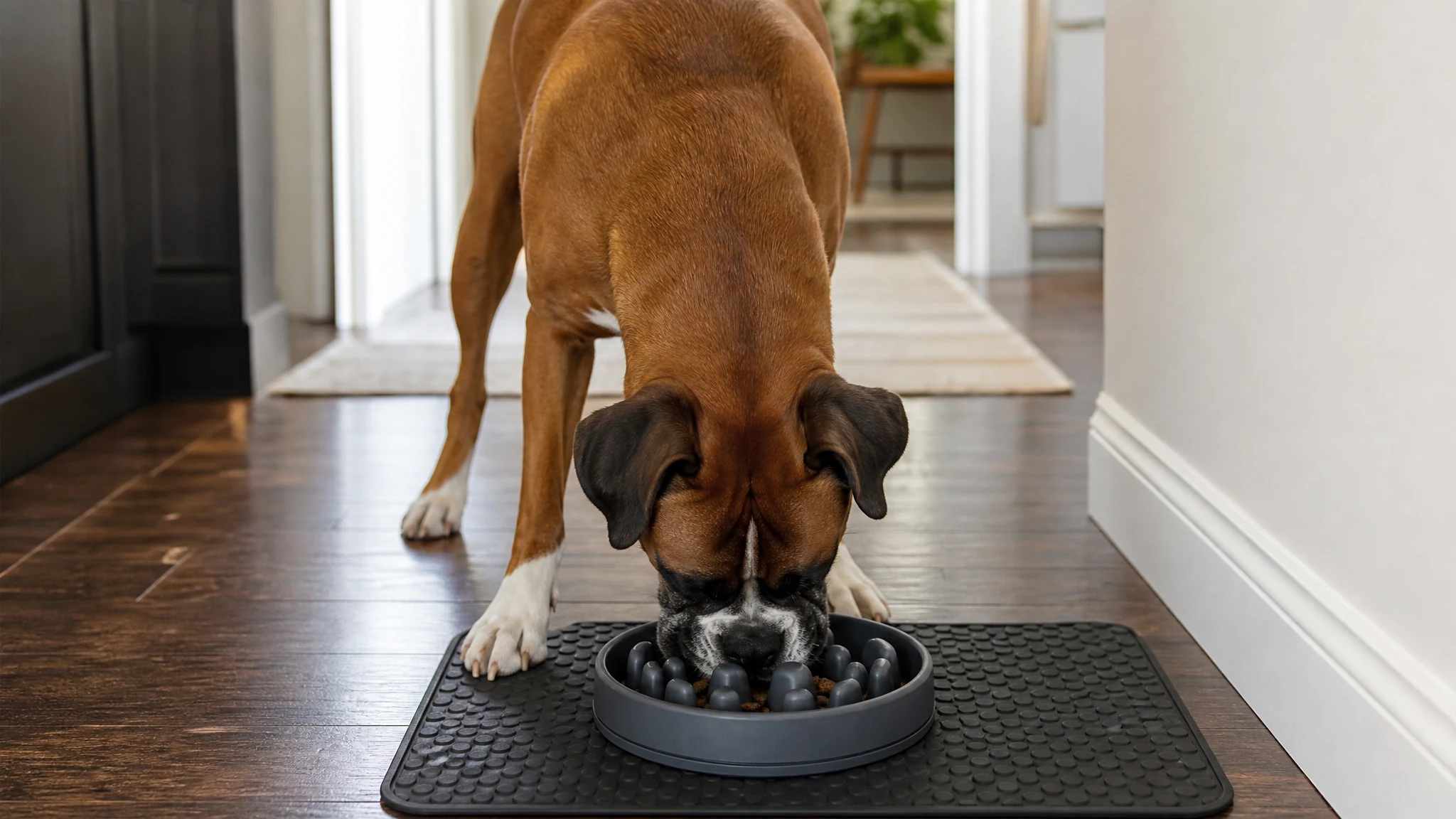
- A slow feeder bowl set on the floor, not raised.
- A vet appointment, before any big diet change.
- A small amount of the new food, only after your vet agrees.
Step 1: Notice the Signs and Write Them Down
A sensitive stomach is not a diagnosis. It is a pattern owners describe. Common things to log include:
- Soft or loose stools that keep coming back.
- Vomiting or regurgitating food.
- Loud belly noises or gas.
- Eating less than usual, or leaving meals.
- Licking lips or drooling around mealtimes.
For one to two weeks, record what your dog ate, the time, treats, and what came out the other end. A log shows your vet far more than a vague memory does.
Know the emergency signs. PetMD's Boxer breed page lists bloat (gastric dilatation-volvulus, or GDV) among the diet-relevant concerns for the breed. Retching with nothing coming up, a swollen belly, or sudden restlessness is not a sensitive stomach. Call an emergency vet right away.
Step 2: Rule Out Medical Causes First
Many things can upset a Boxer's digestion. Parasites, infections, stolen food, and other health problems are a few. Food is only one possibility. Bring your log to the vet and ask whether a diet change makes sense.
Do not try to self-diagnose from a bag claim. The American Boxer Club health page and PetMD both discuss Boxer health conditions. Neither gives a food that treats them. For chronic kidney disease the American Boxer Club page gives no diet advice. For hip dysplasia it says diet and conditioning cannot be ruled out as factors but offers no specific diet advice.
Step 3: Check Feeding Habits Before Changing the Food
Sometimes the way a Boxer eats matters as much as what it eats. PetMD's breed page advises:
- Two meals a day, about 12 hours apart.
- No raised food bowls.
- Slow feeder bowls.
These tips are listed for bloat risk. They are also easy habits to fix first, because gulping can happen with any food. Tell your vet what you change.
Step 4: Read the Label Like a Skeptic
Marketing words like "gentle" or "sensitive" are not defined by the AAFCO nutritional profiles in the way a guaranteed analysis is. Look at these parts instead:
- The nutritional adequacy statement. It tells you whether the food is complete for maintenance, growth, or all life stages.
- The first ingredients. They are listed by weight, so they show what the recipe is mostly made of.
- The guaranteed analysis. Minimum protein and fat, and maximum fiber, where the brand gives them.
- Calories per cup. This lets you compare foods fairly and adjust portions.
For puppies, check the large-size wording. Whole Dog Journal explains that foods labeled for growth or all life stages must say whether they meet the profile "including" or "except for" growth of large-size dogs (70 pounds or more as an adult). Boxers are borderline. PetMD gives adult weight as about 65 to 80 pounds. A Boxer puppy can be fed a food whose label says "including growth of large-size dogs," but this is not a stated requirement. A review in the Canadian Veterinary Journal (Tal et al., 2018) links excess energy during growth to developmental orthopedic disease in large-breed puppies. Ask your vet about your own puppy.
Step 5: Compare Label Data
We compared label data from brand product pages. We did not run feeding trials or taste tests, and we cannot say how any food will agree with your dog. Nothing here is a ranking or a recommendation. It is a way to see what labels actually say. Fields marked "not listed" were not available to us, so check the brand.
| Food | Label statement | First ingredients | Calories | Guaranteed analysis |
|---|---|---|---|---|
| Royal Canin Boxer Adult (dry) | Maintenance; for purebred Boxers 15 months and older | Brown rice, brewers rice, chicken fat, chicken by-product meal, oat groats | 335 kcal per cup (calculated) | Protein 24% min, fat 18% min, fiber 4.5% max |
| Hill's Science Diet Adult Large Breed Chicken & Barley (dry) | Maintenance, AAFCO feeding tests; adults 1 to 5 years, not for large-breed puppies | Chicken, cracked pearled barley, brown rice, brewers rice, whole grain wheat | 365 kcal per cup | Minimums not listed; dry matter averages are given instead |
| VICTOR Elite Canine (dry) | All life stages, including growth of large-size dogs | Chicken meal, whole grain brown rice, grain sorghum, peas, chicken fat | 386 kcal per cup | Protein 25% min, fat 14% min, fiber 4% max |
| Freshpet Home Cooked Chicken (fresh) | Adult maintenance | Chicken, eggs, cranberries, carrots, ground oats | 189 kcal per cup (calculated) | Protein 15% min, fat 11% min, fiber 1% max |
Notice how different these are. Calories per cup range from 189 for the fresh food to 386 for the VICTOR formula, so a cup is not a cup. VICTOR also makes Hi-Pro Plus, whose label says "except for growth of large size dogs," so a growing Boxer puppy needs a closer look at that wording. Kibble size is not listed on most of these pages, so ask the brand if size matters to your dog.
Royal Canin is the only one here with a Boxer-specific formula. The brand describes it for adult purebred Boxers. That is a description of the target dog, not a claim about digestion.
Step 6: Switch Foods Slowly
If your vet agrees to a change, go gradually. Brands give their own timelines. Hill's lists a 7-day transition, VICTOR suggests 7 to 10 days for its Senior Healthy Weight formula, and Freshpet lists 10 days. A common approach is to mix a little new food into the old and increase the share each day. Follow the brand's directions and your vet's advice.
- Measure the old food as usual.
- Replace a small part of it with the new food.
- Increase the new share every day or two, if stools stay normal.
- Pause the increases if stools loosen, and tell your vet if it persists.
Use the brand's feeding guide as a starting point only. Royal Canin, for example, gives tables by weight and activity level. Hill's tells owners to adjust amounts to maintain optimal weight. Excess weight and joint strain are listed as concerns on the PetMD Boxer page, so watch your dog's body condition as well as the bowl.
Step 7: Keep Treats and Extras Out of the Test
Change one thing at a time. Hold treats, chews, table scraps, and supplements steady during the switch. If you do not, you will not know which change caused what. Ask your vet before adding any supplement.
Tips and Common Mistakes
- Switching too fast. A sudden swap can upset even a steady stomach.
- Chasing marketing words. "Sensitive," "natural," and "premium" tell you little. The statement and ingredient panel tell you more.
- Changing food and bowls and treats together. You lose the ability to tell what helped.
- Giving up after two days. Keep logging, and let your vet judge the trend.
- Fearing every grain-free headline. The FDA says it has not found a definitive diet link to non-hereditary dilated cardiomyopathy (DCM) in dogs, and it has not asked for any recalls. It counted 1,382 DCM reports from January 1, 2014 to November 1, 2022. Its Q&A says the agency does not know the specific connection between these diets and cases of non-hereditary DCM. Boxers also have their own inherited heart condition, ARVC, listed by PetMD. That page gives no diet cure for it, but notes Boxers need quality protein for healthy muscles, including the heart.
- Using prescription-style thinking without a prescription. Therapeutic diets are something only a veterinarian prescribes.
What Results to Expect
Results vary by dog. If the cause is diet related, some owners see steadier stools and more regular appetite within a few weeks of a careful switch. That is not certain, and it may not happen. If symptoms continue, get worse, or include blood, weight loss or lethargy, go back to your vet instead of trying another bag.
For a broader look at what matters in a Boxer's bowl, see our guide on Boxer nutrition and the diet factors that matter for this breed.
The Short Version
The best dog food for boxers with sensitive stomachs is the one your vet agrees suits your dog, with a complete label for its life stage, introduced slowly and tracked in a log. Start with the signs, rule out medical causes, fix feeding habits, compare labels, and change one thing at a time.
Sources
- PetMD, Boxer breed page
- American Boxer Club, health page
- Westminster Kennel Club, Boxer breed page
- FDA CVM, Questions and Answers: FDA's Work on Potential Causes of Non-Hereditary DCM in Dogs
- Tal et al., Canadian Veterinary Journal 2018;59(1):36-42
- Whole Dog Journal, In the Fine Print: Nutritional Adequacy Statements
- Royal Canin, Boxer Adult product page
- Hill's Pet Nutrition, Adult Large Breed product page
- VICTOR Pet Food, Elite Canine product page
- Freshpet, Home Cooked Chicken Recipe product page